
A closer look at the tech, AI, and open ecosystem behind Tien Kung 3.0’s real-world push
Updated
February 18, 2026 8:03 PM

Humanoid robots working in a warehouse. PHOTO: ADOBE STOCK
Humanoid robotics has advanced quickly in recent years. Machines can now walk, balance, and interact with their surroundings in ways that once seemed out of reach. Yet most deployments remain limited. Many robots perform well in controlled settings but struggle in real-world environments. Integration is often complex, hardware interfaces are closed, software tools are fragmented, and scaling across industries remains difficult.
Against this backdrop, X-Humanoid has introduced its latest general-purpose platform, Embodied Tien Kung 3.0. The company positions it not simply as another humanoid robot, but as a system designed to address the practical barriers that have slowed adoption, with a focus on openness and usability.
At the hardware level, Embodied Tien Kung 3.0 is built for mobility, strength, and stability. It is equipped with high-torque integrated joints that provide strong limb force for high-load applications. The company says it is the first full-size humanoid robot to achieve whole-body, high-dynamic motion control integrated with tactile interaction. In practice, this means the robot is designed to maintain balance and execute dynamic movements even in uneven or cluttered environments. It can clear one-meter obstacles, perform consecutive high-dynamic maneuvers, and carry out actions such as kneeling, bending, and turning with coordinated whole-body control.
Precision is also a focus. Through multi-degree-of-freedom limb coordination and calibrated joint linkage, the system is designed to achieve millimeter-level operational accuracy. This level of control is intended to support industrial-grade tasks that require consistent performance and minimal error across changing conditions.
But hardware is only part of the equation. The company pairs the robot with its proprietary Wise KaiWu general-purpose embodied AI platform. This system supports perception, reasoning, and real-time control through what the company describes as a coordinated “brain–cerebellum” architecture. It establishes a continuous perception–decision–execution loop, allowing the robot to operate with greater autonomy and reduced reliance on remote control.
For higher-level cognition, Wise KaiWu incorporates components such as a world model and vision-language models (VLM) to interpret visual scenes, understand language instructions, and break complex objectives into structured steps. For real-time execution, a vision-language-action (VLA) model and full autonomous navigation system manage obstacle avoidance and precise motion under variable conditions. The platform also supports multi-agent collaboration, enabling cross-platform compatibility, asynchronous task coordination, and centralized scheduling across multiple robots.
A central part of the platform is openness. The company states that the system is designed to address compatibility and adaptation challenges across both development and deployment layers. On the hardware side, Embodied Tien Kung 3.0 includes multiple expansion interfaces that support different end-effectors and tools, allowing faster adaptation to industrial manufacturing, specialized operations, and commercial service scenarios. On the software side, the Wise KaiWu ecosystem provides documentation, toolchains, and a low-code development environment. It supports widely adopted communication standards, including ROS2, MQTT, and TCP/IP, enabling partners to customize applications without rebuilding core systems.
The company also highlights its open-source approach. X-Humanoid has open-sourced key components from the Embodied Tien Kung and Wise KaiWu platforms, including the robot body architecture, motion control framework, world model, embodied VLM and cross-ontology VLA models, training toolchains, the RoboMIND dataset, and the ArtVIP simulation asset library. By opening access to these elements, the company aims to reduce development costs, lower technical barriers, and encourage broader participation from researchers, universities, and enterprises.
Embodied Tien Kung 3.0 enters a market where technical progress is visible but large-scale adoption remains uneven. The gap is not only about movement or strength. It is about integration, interoperability, and the ability to operate reliably and autonomously in everyday industrial and commercial settings. If platforms can reduce fragmentation and simplify deployment, humanoid robots may move beyond demonstrations and into sustained commercial use.
In that sense, the significance of Embodied Tien Kung 3.0 lies less in isolated technical claims and more in how its high-dynamic hardware, embodied AI system, open interfaces, and collaborative architecture are structured to work together. Whether that integrated approach can close the deployment gap will shape how quickly humanoid robotics becomes part of real-world operations.
Keep Reading
How a Korean biotech startup is using AI to move drug discovery from trial-and-error to precision design
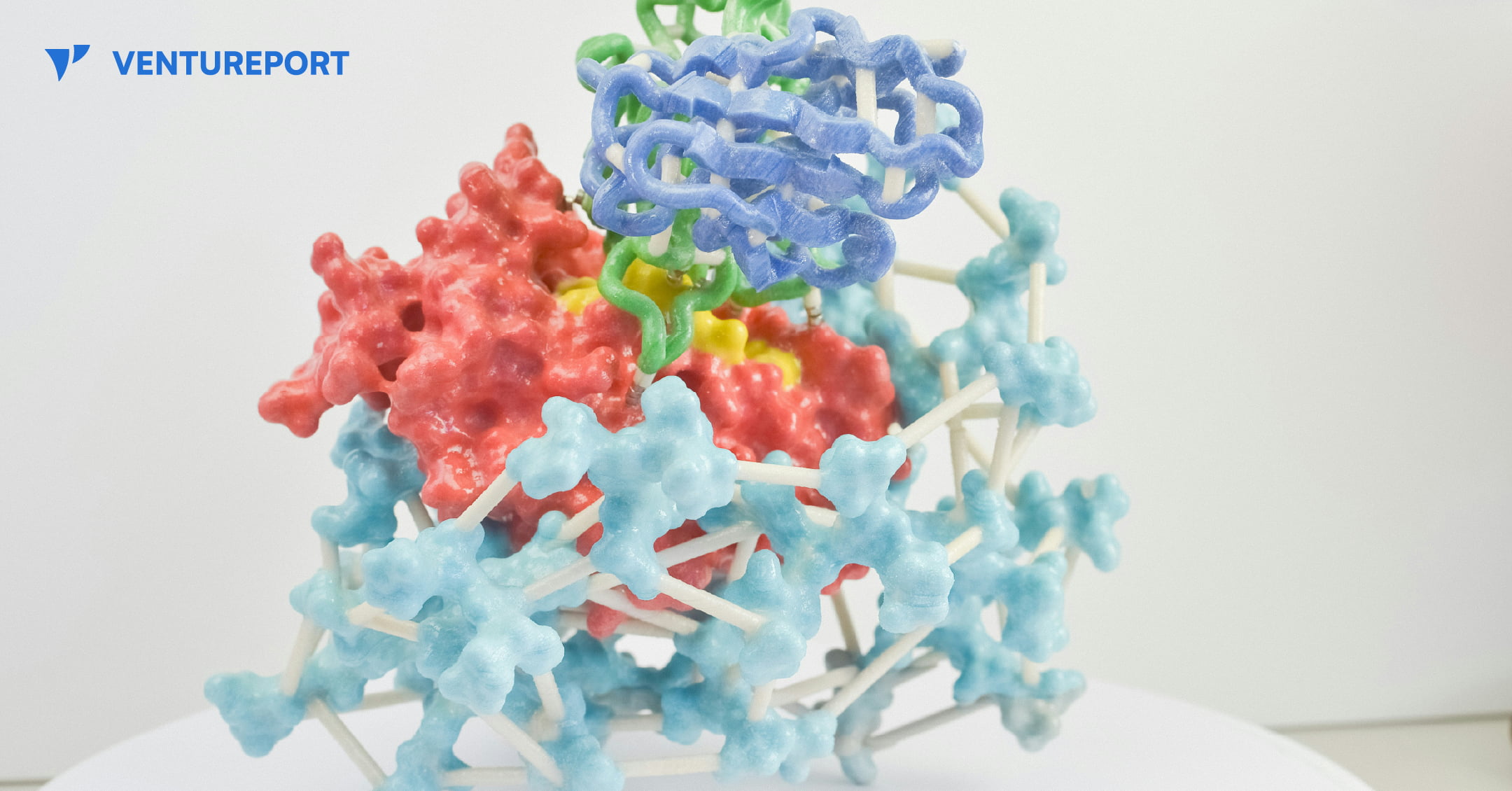
A close up of a protein structure model. PHOTO: UNSPLASH
For decades, drug discovery has relied on trial and error, with scientists testing thousands of molecules to find one that works. Galux, a South Korean biotech startup, is changing that by using AI to design proteins from scratch. This method, called “de novo” design, makes it possible to build precise new therapies instead of searching through existing ones.
The company recently announced a US$29 million Series B funding round, bringing its total capital to US$47 million.This significant investment attracted a substantial roster of institutional backers, including the Korea Development Bank (KDB), Yuanta Investment, SL Investment and NCORE Ventures. These firms joined existing investors such as InterVest, DAYLI Partners and PATHWAY Investment, as well as new participants including SneakPeek Investments, Korea Investment & Securities and Mirae Asset Securities.
At the core of the company’s work is a platform called GaluxDesign. Unlike many AI tools that only predict how existing proteins fold, this system uses deep learning and physics to create entirely new therapeutic antibodies. This “from scratch” approach lets the team go after so-called “undruggable” proteins. These are targets that traditional small-molecule drugs can’t reach because they lack clear binding pockets. By designing proteins to fit these complex shapes, Galux aims to unlock treatments that have stayed out of reach for decades. And that’s exactly why investors are paying attention.
The pharmaceutical industry is actively looking for faster and more efficient ways to develop new drugs, and Galux is built for exactly that. The company connects its AI platform directly to its own wet lab, where designs can be tested in real time. Each result feeds straight back into the system, sharpening the next round of models. This continuous loop speeds up discovery and improves precision at every step. It’s also why partners like Celltrion, LG Chem and Boehringer Ingelheim are already working with Galux.
Galux is no longer just trying to make drugs that stick to a target. The company now wants its AI to design medicines that actually work in the body and can be made at scale. In simple terms, a drug has to do more than bind to a disease—it must be stable, safe and strong enough to change how the illness behaves. Galux is moving into tougher targets such as ion channels and GPCRs. These play key roles in heart function and sensory signals. Ultimately, the goal is to show that AI-driven design can turn complex biology into real treatments. And instead of hunting blindly for a solution, the team is building exactly what they need.