
A closer look at the tech, AI, and open ecosystem behind Tien Kung 3.0’s real-world push
Updated
February 18, 2026 8:03 PM

Humanoid robots working in a warehouse. PHOTO: ADOBE STOCK
Humanoid robotics has advanced quickly in recent years. Machines can now walk, balance, and interact with their surroundings in ways that once seemed out of reach. Yet most deployments remain limited. Many robots perform well in controlled settings but struggle in real-world environments. Integration is often complex, hardware interfaces are closed, software tools are fragmented, and scaling across industries remains difficult.
Against this backdrop, X-Humanoid has introduced its latest general-purpose platform, Embodied Tien Kung 3.0. The company positions it not simply as another humanoid robot, but as a system designed to address the practical barriers that have slowed adoption, with a focus on openness and usability.
At the hardware level, Embodied Tien Kung 3.0 is built for mobility, strength, and stability. It is equipped with high-torque integrated joints that provide strong limb force for high-load applications. The company says it is the first full-size humanoid robot to achieve whole-body, high-dynamic motion control integrated with tactile interaction. In practice, this means the robot is designed to maintain balance and execute dynamic movements even in uneven or cluttered environments. It can clear one-meter obstacles, perform consecutive high-dynamic maneuvers, and carry out actions such as kneeling, bending, and turning with coordinated whole-body control.
Precision is also a focus. Through multi-degree-of-freedom limb coordination and calibrated joint linkage, the system is designed to achieve millimeter-level operational accuracy. This level of control is intended to support industrial-grade tasks that require consistent performance and minimal error across changing conditions.
But hardware is only part of the equation. The company pairs the robot with its proprietary Wise KaiWu general-purpose embodied AI platform. This system supports perception, reasoning, and real-time control through what the company describes as a coordinated “brain–cerebellum” architecture. It establishes a continuous perception–decision–execution loop, allowing the robot to operate with greater autonomy and reduced reliance on remote control.
For higher-level cognition, Wise KaiWu incorporates components such as a world model and vision-language models (VLM) to interpret visual scenes, understand language instructions, and break complex objectives into structured steps. For real-time execution, a vision-language-action (VLA) model and full autonomous navigation system manage obstacle avoidance and precise motion under variable conditions. The platform also supports multi-agent collaboration, enabling cross-platform compatibility, asynchronous task coordination, and centralized scheduling across multiple robots.
A central part of the platform is openness. The company states that the system is designed to address compatibility and adaptation challenges across both development and deployment layers. On the hardware side, Embodied Tien Kung 3.0 includes multiple expansion interfaces that support different end-effectors and tools, allowing faster adaptation to industrial manufacturing, specialized operations, and commercial service scenarios. On the software side, the Wise KaiWu ecosystem provides documentation, toolchains, and a low-code development environment. It supports widely adopted communication standards, including ROS2, MQTT, and TCP/IP, enabling partners to customize applications without rebuilding core systems.
The company also highlights its open-source approach. X-Humanoid has open-sourced key components from the Embodied Tien Kung and Wise KaiWu platforms, including the robot body architecture, motion control framework, world model, embodied VLM and cross-ontology VLA models, training toolchains, the RoboMIND dataset, and the ArtVIP simulation asset library. By opening access to these elements, the company aims to reduce development costs, lower technical barriers, and encourage broader participation from researchers, universities, and enterprises.
Embodied Tien Kung 3.0 enters a market where technical progress is visible but large-scale adoption remains uneven. The gap is not only about movement or strength. It is about integration, interoperability, and the ability to operate reliably and autonomously in everyday industrial and commercial settings. If platforms can reduce fragmentation and simplify deployment, humanoid robots may move beyond demonstrations and into sustained commercial use.
In that sense, the significance of Embodied Tien Kung 3.0 lies less in isolated technical claims and more in how its high-dynamic hardware, embodied AI system, open interfaces, and collaborative architecture are structured to work together. Whether that integrated approach can close the deployment gap will shape how quickly humanoid robotics becomes part of real-world operations.
Keep Reading
Updated
January 8, 2026 6:33 PM

A group of entrepreneurs coming up with different ideas. PHOTO: FREEPIK
If startup success stories usually make you picture cutting-edge tech, you might be missing a big part of the picture. Sometimes, the weirdest ideas shine the brightest, making real money and delighting both founders and customers. From ordinary rocks turned into pets to renting live chickens, these unusual startups show how far creativity and a pinch of humor can go.
If you think the business world is all suits and serious pitches, think again—welcome to the wonderfully weird side of entrepreneurship.

Owning a pet is a joy, but let’s be honest—it’s also a handful. Between shedding fur, endless feeding schedules, surprise messes and finding a sitter when you’re away, pet parenting is not exactly effortless.
Back in 1975, an advertising executive named Gary Dahl found himself joking about this very problem over drinks with friends. His solution for the “perfect” pet: a rock. No feeding, no walking, no grooming and absolutely no accidents on the carpet.
What started as a joke quickly snowballed into a real business. Smooth stones were sourced from Rosarito Beach in Mexico, then packed in playful cardboard “pet carrier” boxes with little air holes and a bed of straw. To make the experience even more cheeky, every Pet Rock came with a care manual that instructed owners to give their new companion sunlight, affection and, of course, a name.
It was absurd and hilarious, but it worked. Selling at US$3.95 apiece in the ’70s, Pet Rocks became a cultural phenomenon. Today, you can still find them on Amazon, but they will now set you back around US$29.99 or more. Would you bring home a Pet Rock? People in the ’70s sure did.

Back in 2013, Phil and Jenn Tompkins a couple duo, launched the company "Rent The Chicken" with one straightforward goal: give people a chance to try raising backyard hens and enjoy fresh eggs without the long-term commitment.
Through partnerships with local farmers across the U.S. and Canada, this backyard chicken rental startup brings egg-laying hens straight to people’s yards. It offers different rental packages, but a standard six-month rental costs around US$500. This usually includes two hens ready to lay within days, a portable coop, feed, food and water dishes and expert support for any chicken-related questions.
The chickens arrive in spring and stay until fall. When the season ends, families can choose to return the hens, extend the rental or even buy them for about US$40 each at the end of the contract.
Today, the company works with partners in 29 states, from Oregon to Texas, and in parts of Canadain p. For people outside those areas, an out-of-area purchase package that comes with three hens can be shipped anywhere in the 48 contiguous states in the U.S. for about US$1,550.
In a way, it’s a fun and hands-on path to food security — giving families the joy of collecting their own eggs and knowing exactly where their breakfast comes from.

By day, Gadlin worked as a full-time web developer for a television broadcasting company. Outside of work, he poured his energy into comedy and writing. That creative streak took him back to high school days, when he had drawn silly cats for a comic series called Silly Cats Comic.
With those doodles as his foundation and a bit of basic design know-how, Gadlin launched his website, “I Want to Draw a Cat For You” in 2011. The concept was as simple as it was funny: visitors would describe the cat of their dreams and Gadlin would personally hand-draw it, then send it their way.
This quirky startup idea landed him on Shark Tank, where he secured an offer of US$25,000 from investor Mark Cuban for a 33% stake in the business. Not bad for stick-figure cats.
When the site first launched, customers could pay extra US$5 for colour. Shipping cost US$1 if they didn’t mind the drawing arriving in a folded envelope, or US$5 for a flat mailer. For delivery within 48 hours, there was a US$19.95 rush fee that many customers were happy to pay.
These days, Gadlin leans more on digital delivery and limited runs of his cat drawings at US$50, rather than mailing every single piece of his art. What he once described as “mediocre cat drawings” has become proof that a simple, original idea can claw its way into the startup world.

Imagine arriving in a new city with no one to show you around. That is exactly the kind of situation where RentAFriend can help.
Launched in 2009 by Scott Rosenbaum, the unusual business was inspired by Japan’s “rental family” services, where people can hire a friend, a date or even a parent for a short period. Rosenbaum saw an opportunity to adapt that concept for North America, but with a focus strictly on platonic friendship.
Here’s how it works: Anyone can sign up as a “friend” for free by creating a profile, listing their interests and setting an hourly rate. People who want to hire pay a membership fee, typically around US$24.95 a month, to connect with friends across the platform.
With a rented friend, you can do pretty much anything platonic. Go sightseeing, hit a museum, catch a game, work out together or even bring them along to a party or family event. At its heart, RentAFriend connects people who need company with those happy to earn a little extra simply by being one.
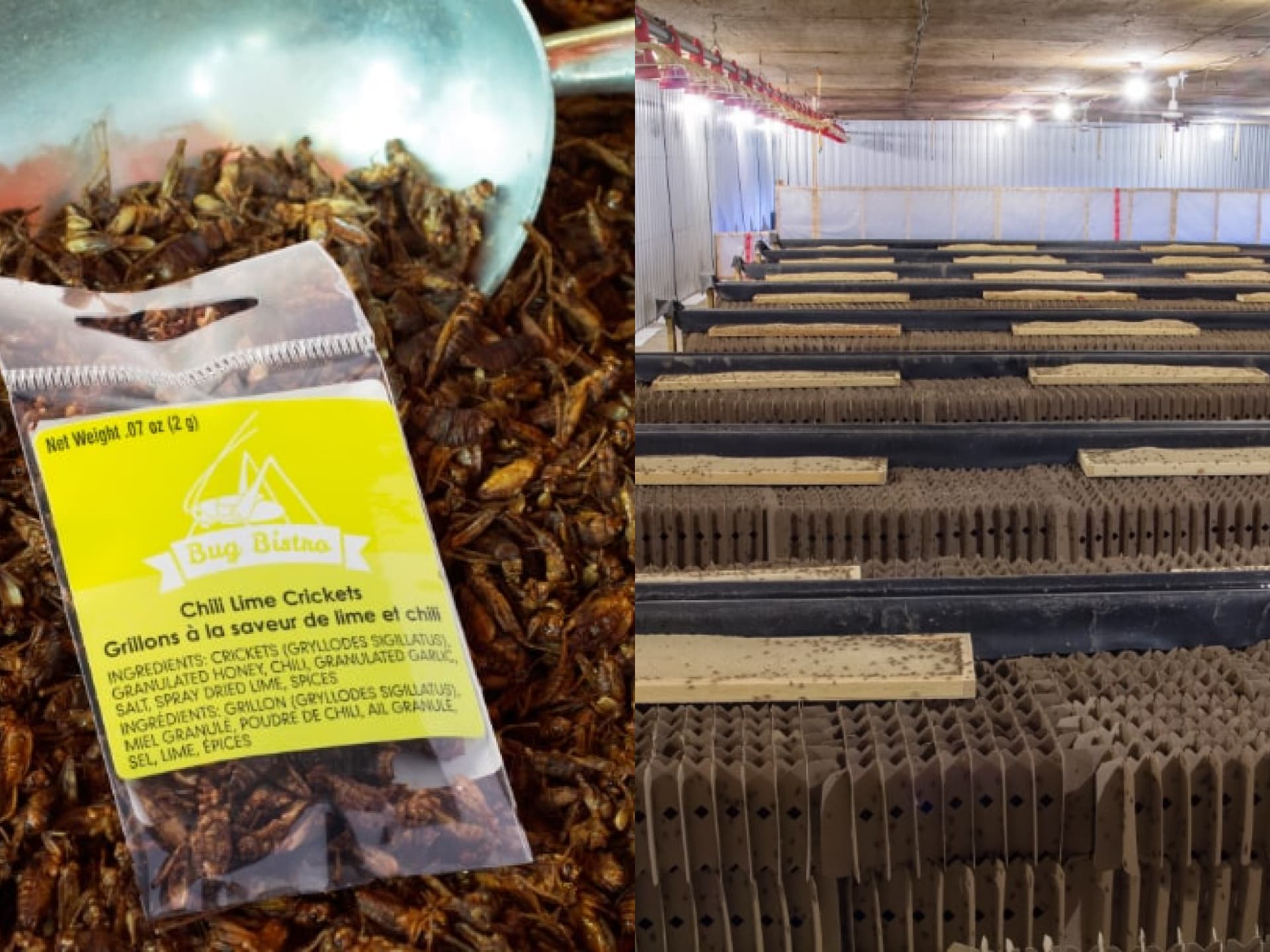
Back in 2014, in the small town of Norwood, Ontario, Canada, three brothers—Jarrod, Darren and Ryan Goldin, set out to do something that sounded downright bizarre at the time: farm crickets for people to eat.
The idea first struck Jarrod after he saw a cricket-based nutrition bar on television. Around the same time, the UN released a report on edible insects as a sustainable food source. Suddenly, the “weird” idea didn’t seem so weird after all.
At Entomo Farms, crickets are raised in cage-free “cricket condos”, where they live in warm, dark spaces that mimic their natural habitat. They’re fed and cared for until they reach about six or seven weeks old, then humanely harvested using a CO₂ method. From there, they’re rinsed, roasted and ground into a fine powder—no additives, just pure cricket protein.
The appeal goes beyond novelty. Crickets are packed with nutrients and need far less land, feed and water than beef, making them both healthy and eco-friendly.
While their approach may seem unconventional, what drives Entomo Farms is simple: making sustainable, responsible food accessible to everyone.
These startups prove that innovation doesn’t always wear a serious face. Sometimes, it turns up wrapped in humor, curiosity or even a touch of absurdity, yet still manages to spark real change. From crickets turned into protein to chickens rented out by the season, each weird startup idea shows that entrepreneurship thrives when people dare to think differently.
While some of these unusual business ideas burned bright then faded, others are still evolving in the background, shifting from fads to niche services or steady, quiet companies. What they share is a willingness to test an idea most people would dismiss at first glance.
That is the real takeaway for founders. Weird startup ideas will not always scale into unicorns, yet they can test new consumer habits, open up fresh markets and shape culture in surprising ways. If you are building something new, there is space for products that make people laugh, think or raise an eyebrow before they reach for their wallet.