
Inside a partnership showing how open-source platforms and startups are scaling autonomous driving beyond the lab.
Updated
January 8, 2026 6:30 PM
.jpg)
A Robotaxi prototype developed by TIER IV. PHOTO: TIER IV
Autonomous driving is often discussed in terms of futuristic cars and distant timelines. This investment is about something more immediate. Japan-based TIER IV has invested in Turing Drive, a Taiwan startup that builds autonomous driving systems designed for controlled, everyday environments such as factories, ports, airports and industrial campuses. The investment establishes a capital and business alliance between the two companies, with a shared focus on developing autonomous driving technology and expanding operations across Asia.
Rather than targeting open roads and city traffic, Turing Drive’s work centres on places where vehicles follow fixed routes and move at low speeds. These include logistics hubs, manufacturing facilities and commercial sites where automation is already part of daily operations. According to the release, Turing Drive has deployments across Taiwan, Japan and other regions and works closely with vehicle manufacturers to integrate autonomous systems into special-purpose vehicles.
The investment also connects Turing Drive more closely with Autoware, an open-source autonomous driving software ecosystem supported by TIER IV. Turing Drive joined the Autoware Foundation in September 2024 and develops its systems using this shared software framework. TIER IV’s own Pilot.Auto platform, which is built around Autoware, is used across applications such as factory transport, public transit, freight movement and autonomous mobility services.
Through the alliance, TIER IV plans to work with Turing Drive to further develop autonomous driving systems for these controlled environments, while strengthening its presence in Taiwan and the broader Asia-Pacific region. The collaboration brings together software development and on-the-ground deployment experience within markets where autonomous driving is already being tested in real operational settings.
“This partnership with Turing Drive represents a significant step forward in accelerating the deployment of autonomous driving across Asia”, said TIER IV CEO Shinpei Kato. “At TIER IV, our mission has always been to make autonomous driving accessible to all. By collaborating with Turing Drive, which has demonstrated remarkable achievements in real-world deployments in Taiwan, we aim to deliver autonomous driving that enables a safer, more sustainable and more inclusive society”.
“We are thrilled to establish this strategic alliance with TIER IV, a global leader in open-source autonomous driving”, said Weilung Chen, chairman of Turing Drive. “In Taiwan, autonomous driving deployment is gaining significant momentum, particularly across logistics hubs, ports, airports and industrial campuses. By combining our field expertise with TIER IV's world-class Pilot.Auto platform, we aim to accelerate the development of practical, commercially viable mobility services powered by autonomous driving”. Overall, the investment highlights how autonomous driving in Asia is being shaped by operational needs and gradual integration, rather than headline-grabbing demonstrations.
Keep Reading
Bitmo Lab is testing an ultra-thin, bendable tracker built to fit inside items traditional trackers can’t
Updated
February 12, 2026 4:43 PM
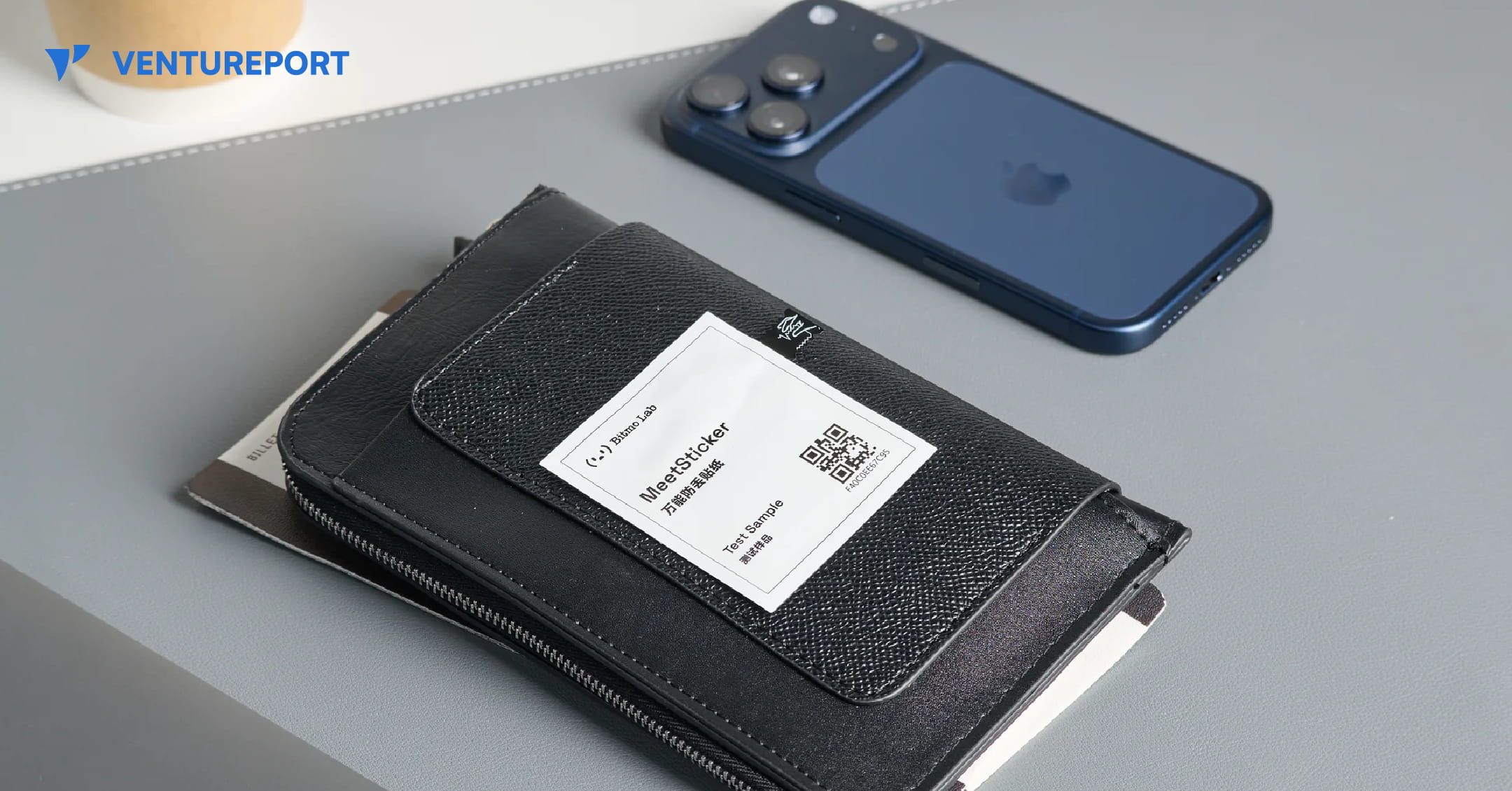
Bitmo Lab's MeetSticker tracker. PHOTO: BITMO LAB
Location trackers have become everyday accessories for keys, bags and luggage. But as personal items grow slimmer and more design-focused — from minimalist wallets to passport sleeves and specialised gear — tracking them has become less straightforward. Most trackers are built as small, rigid discs that assume the presence of space, loops or compartments. That assumption has created a growing mismatch between modern product design and the technology meant to secure it.
Hong Kong–based startup Bitmo Lab is attempting to address that gap with a device called MeetSticker. Instead of the solid plastic casing typical of most trackers, MeetSticker is engineered to be flexible and ultra-thin, measuring just 0.8 millimetres thick. The bendable design allows it to sit within narrow compartments or along curved surfaces without altering the shape of the object. Rather than attaching to an item externally, it is intended to integrate discreetly inside it.
That structural shift is the core of the product’s proposition. By removing the rigid shell that defines conventional tracking hardware, MeetSticker can be placed in items that previously had no practical way to accommodate a tracker. Bitmo Lab states that the device connects through a proprietary network and a companion application compatible with both iOS and Android, positioning it as a cross-platform solution rather than one tied to a single ecosystem.
The implications extend beyond form factor. Objects without obvious attachment points — such as compact travel accessories or specialised tools — could potentially be monitored without visible add-ons. In doing so, the device broadens the scope of tracking technology into categories where aesthetics, aerodynamics or compact design matter as much as functionality.
Before moving toward retail distribution, however, the company is focusing on validation. Bitmo Lab has launched a five-week global alpha testing programme beginning February 9. Sixty participants will receive a prototype unit and early access to the app. According to the company, the programme is designed to assess durability, usability and real-world performance before a wider commercial release. Participants who provide feedback will receive a retail unit upon launch.
Such testing is particularly relevant for flexible electronics. Unlike rigid devices, bendable hardware must withstand repeated flexing, daily handling and environmental exposure. Early user data can help refine manufacturing processes and software optimisation before scaling production.
As with other connected tracking devices, privacy considerations remain part of the equation. Bitmo Lab has stated that data collected during the alpha programme will be used strictly for testing purposes and deleted once the programme concludes.
Whether flexible trackers will redefine the category will depend on how they perform outside controlled testing environments. Still, the introduction of a near-invisible, bendable tracking device reflects a broader shift in consumer technology. As everyday products become thinner and more design-conscious, the tools built to protect them may need to adapt just as seamlessly.