
A global survey shows robot anxiety drops when people encounter robots in real life
Updated
March 13, 2026 2:25 PM

Ameca the humanoid robot, featuring a grey rubber face. PHOTO: ADOBE STOCK
People often assume robots make people uneasy everywhere. But a new global study suggests something more nuanced. Robot anxiety tends to be highest in places where people rarely see robots in real life. Where robots are more visible, attitudes are often far more positive. That insight comes from a global study by Hexagon AB, which surveyed 18,000 participants across nine major markets. The research explored how adults and children think about robots and how those views change depending on everyday exposure.
In the United Kingdom, anxiety about robots is the highest among the countries studied. Around 52% of adults say they feel worried that something might go wrong when they think about interacting with or working alongside robots. South Korea sits at the other end of the spectrum, with only 29% reporting similar concerns. One factor appears to explain much of the gap: familiarity.
British adults are among the least likely to have encountered robots in real life. Only about 30% say they have seen or used one. In contrast, countries where robots are more visible tend to report greater comfort. China offers the clearest example. Around 75% of adults there say they have seen or interacted with robots. At the same time, 81% say they feel excited about the technology’s future potential.
The study suggests that attitudes toward robots are not fixed. Instead, they shift depending on where people encounter them and what tasks they perform. When robots are seen solving clear, practical problems, confidence tends to rise.
Across the surveyed countries, adults report the highest comfort levels with robots working in factories and warehouses. Around 63% say they are comfortable with robots in those environments. These are settings where tasks are clearly defined and safety standards are well understood. Acceptance drops in more personal spaces. Only 46% say they feel comfortable with robots in the home, while comfort falls further to 39% when robots are imagined in classrooms.
In other words, context matters. People appear more willing to accept robots when they take on physically demanding or dangerous work. Half of the respondents say improved safety is one of the main advantages of robotics in those environments. A similar share point to productivity gains as another benefit. Another finding challenges a common assumption about public fears. Job loss is often described as the biggest concern surrounding robotics. But the study suggests security risk worries people more.
Around 51% of adults say their biggest concern about robots at work is the possibility that the machines could be hacked or misused. That fear outweighs worries about physical malfunction or injury, which stand at 41%. Concerns about being replaced at work appear at the same level.
For many respondents, the issue is not simply whether robots can perform tasks. It is whether the systems controlling them are secure. According to researchers involved in the study, these concerns reflect how people evaluate emerging technologies. Instead of having a single opinion about robotics, people tend to judge each situation individually.
A robot helping assemble products in a factory may feel acceptable. The same technology operating in more sensitive environments can raise different questions. Dr. Jim Everett, an associate professor in moral psychology, says trust in artificial intelligence and robotics is often misunderstood. People are not simply asking whether they trust the technology, he notes. They are thinking about specific tools performing specific roles.
A robot assisting in a classroom or helping in healthcare carries different expectations than an AI system used in defense or surveillance. Even though these technologies are often grouped together in public debates, people evaluate them differently depending on their purpose.
Finally, the study also highlights another important factor shaping public attitudes: experience. When people actually encounter robots, fear often declines. Michael Szollosy, a robotics researcher involved in the project, says reactions tend to change quickly when individuals meet a robot for the first time.
The idea of an autonomous machine can feel intimidating in theory. But when people see a small service robot or an industrial machine performing a straightforward task, the reaction is often much calmer. Exposure can shift perceptions from abstract fears to practical understanding.
That shift matters because robotics is moving steadily into everyday environments. From manufacturing and logistics to healthcare and public services, machines capable of autonomous or semi-autonomous work are becoming more common.
As that happens, the study suggests public confidence may depend less on technical breakthroughs and more on visibility and transparency. Burkhard Boeckem, chief technology officer at Hexagon AB, argues that trust grows when people understand what robots are designed to do and where their limits lie.
Anxiety tends to increase when systems feel invisible or poorly understood. Clear boundaries and clear explanations can have the opposite effect. When people see robots working safely alongside humans, performing well-defined tasks and operating within clear rules, the technology becomes easier to accept.
In that sense, the future of robotics may depend as much on public familiarity as on engineering. The machines themselves are advancing quickly. But the relationship between humans and robots is still being negotiated. For now, the study offers a simple insight: the more people encounter robots in everyday life, the less mysterious they become. And once the mystery fades, the conversation often changes from fear to curiosity.
Keep Reading
From AI love affairs to cosmic survival, 2026 has it all.
Updated
January 8, 2026 6:28 PM

A man in a space suit looking upon a ringed marble. PHOTO: UNSPLASH
Grab your popcorn—the 2026 sci-fi movie slate is stacked. We’re getting everything from post-apocalyptic survival films to AI thrillers, plus a big-space adventure and a fresh DC superhero story. Some films launch new worlds, others expand familiar ones, but all of them aim to leave an impression, but all of them look like the kind of movies you’ll want to talk about after the credits.
Here are five upcoming sci-fi movies to mark on your calendar.

Release Date: January 9, 2026
Director: Kate Dolan
Stars: Lily Sullivan, David Rysdahl and Claudia Doumit
If you like your sci-fi with a creepy edge, Soulm8te is very much in that lane. A spin-off from the M3GAN universe, the film follows a man grieving the loss of his wife who turns to an AI android to ease the pain. At first, it seems to help. The connection feels real, even comforting. But before long, it becomes a little too real and slips into something far more dangerous. What makes Soulm8te unsettling is how close it feels to the present. AI companions are no longer science fiction, and the film plays with that reality in a way that feels intimate rather than futuristic. Directed by Kate Dolan, the story stays on quiet unease instead of spectacle, allowing tension to build as affection turns possessive and attachment becomes dangerous. The film is produced by Allison Williams and James Wan, both closely involved in the hit horror franchise M3GAN, and their experience with technology-driven horror is clearly felt here. Fans of grounded, psychological sci-fi should keep this one on their radar.

Release Date: January 9, 2026
Director: Ric Roman Waugh
Stars: Gerard Butler, Morena Baccarin, Amber Rose Revah, Sophie Thompson, Trond Fausa Aurvåg
Back in 2020, Greenland introduced audiences to John Garrity (Gerard Butler), a father racing against time to save his family as comet fragments threatened to wipe out life on Earth. The film ended with survivors heading into bunkers deep in Greenland, hanging on to the last thin thread of hope. This sequel follows the Garrity family as they leave the safety of underground shelters and face a world that no longer resembles home. The setting moves across a battered Europe, where every decision carries weight and every journey feels uncertain. Rather than repeating the ticking-clock chaos of the original, Migration leans into endurance, exhaustion and the question of whether rebuilding is even possible. It’s a post-apocalyptic movie about movement, loss and the cost of starting over.
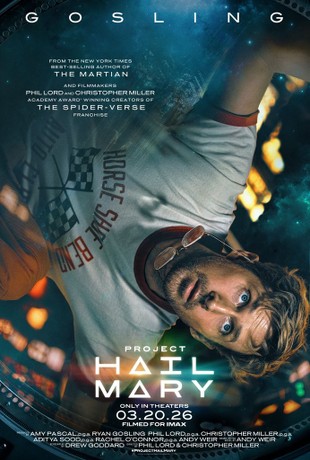
Release Date: March 20, 2026
Director: Phil Lord & Chris Miller
Stars: Ryan Gosling, Milana Vayntrub, Sandra Hüller
Based on Andy Weir’s best-selling novel, Project Hail Mary is shaping up to be one of the most talked-about space survival films of 2026. Ryan Gosling stars as Ryland Grace, an unlikely astronaut whose journey into space begins with confusion rather than heroics. Grace, a former junior high science teacher, wakes up alone on a spacecraft, cut off from Earth and missing key memories about how he got there. As pieces slowly fall into place, so does the scale of the problem he’s been sent to solve. The film blends real science with high-stakes isolation, balancing quiet moments with the pressure of a mission that affects the entire planet. Directed by Phil Lord and Chris Miller, Project Hail Mary promises tension, curiosity and a heavy dose of human vulnerability set against the vastness of space.

Release Date: March 27, 2026
Director: Ridley Scott
Stars: Jacob Elordi, Josh Brolin
The Dog Stars strips the apocalypse down to its bare essentials. Based on Peter Heller’s novel of the same name, the film features a screenplay by Mark L. Smith and Christopher Wilkinson, known for The Revenant and Ali. The setup of The Dog Stars is simple and bleak: a virus has erased most of humanity. What’s left is silence, abandoned airfields and roaming scavengers known as the “Reapers” who prey on the few survivors left behind.
Jacob Elordi plays Hig, a pilot living in isolation with his dog and a heavily armed companion. His days follow a strict routine, broken only by short flights in his aging Cessna. That fragile balance shatters when a distant radio signal breaks through the quiet. It’s the first real sign of life he has heard in years, and it draws him toward a journey that could change everything. Directed by Ridley Scott, the film focuses less on large-scale destruction and more on loneliness, hope and the risk of reaching out in a broken world. The result is a post-apocalyptic thriller that feels intimate, reflective and quietly tense.

Release Date: June 26, 2026
Director: Craig Gillespie
Stars: Milly Alcock, Jason Momoa, Matthias Schoenaerts
Supergirl: Woman of Tomorrow offers a very different take on the DC universe. This is a cosmic sci-fi story first, superhero film second. Kara Zor-El is older, tougher and shaped by memories of a world she lost. Unlike her cousin Superman, she remembers the destruction of Krypton clearly, and that history weighs heavily on her. The film follows Kara as she crosses paths with a young alien seeking justice, pulling her into a dangerous journey across distant worlds. Rather than focusing on Earth-saving spectacle, the story explores identity, grief and what heroism looks like far from home. With Milly Alcock stepping into the role, Supergirl 2026 aims to expand DC’s sci-fi side while giving the character emotional depth rarely seen on screen.
One reason science fiction movies stick with us is that they ask big questions in a way that feels personal. What happens when tech starts filling emotional gaps? What does survival look like when the world doesn’t bounce back? And how far would you go to save everyone you’ve ever known? If you’re looking for 2026 sci-fi movies that range from gritty to hopeful to unsettling, this lineup has you covered.