
HyveGeo’s approach to restoring degraded land stands out at the FoodTech Challenge
Updated
February 7, 2026 2:18 PM

Clusters of sandstone buttes in Monument Valley, Colorado Plateau. PHOTO: UNSPLASH
HyveGeo, a climate-focused startup, has been named one of the global winners of the FoodTech Challenge, an international competition designed to surface practical technologies that strengthen food systems in arid and climate-stressed regions.
The FoodTech Challenge (FTC) is based in the UAE and brings together governments, foundations and agri-food institutions to identify early-stage solutions that address food production, land degradation and resource efficiency. Each year, hundreds of startups apply from around the world. In 2026, more than 1,200 teams from 113 countries submitted entries. Only four were selected.
HyveGeo stood out for its approach to one of agriculture’s hardest problems: how to make desert soil usable again. Founded in 2023 by a group of scientists and researchers, the Abu Dhabi-based company focuses on regenerating degraded land using a process built around biochar, a carbon-rich material made from agricultural waste, enhanced with microalgae. The aim is to accelerate soil recovery in environments where water is limited and land has been heavily stressed.
What caught the judges’ attention was not just the technology itself, but the way it links several challenges at once. The system turns waste into a usable soil input, reduces the time it takes for land to become productive and locks carbon into the ground instead of releasing it into the atmosphere. In short, it addresses land degradation, food production and climate pressure through a single framework.
As a winner of the FoodTech Challenge, HyveGeo will share a US$2 million prize with the other selected startups. Beyond funding, the company will also receive support from the UAE’s innovation ecosystem, including research backing, pilot projects, market access and incubation services to help move from testing into wider deployment.
The team’s plans focus on scaling within the UAE first. HyveGeo aims to work across Abu Dhabi’s network of farms and gradually expand into other arid and climate-stressed regions. Its longer-term target is to restore thousands of hectares of degraded land and contribute to carbon removal through soil-based methods.
Placed in a broader context, HyveGeo’s win reflects a shift in how food and climate technologies are being evaluated. Instead of chasing dramatic breakthroughs, competitions like the FTC are increasingly backing systems that connect waste, land, water and carbon into something usable on the ground. Not futuristic agriculture, but practical repair work for environments that can no longer rely on old farming assumptions. If that direction continues, the next wave of food innovation may be less about spectacle and more about quiet, scalable fixes for places where growing food has become hardest.
Keep Reading
Bitmo Lab is testing an ultra-thin, bendable tracker built to fit inside items traditional trackers can’t
Updated
February 12, 2026 4:43 PM
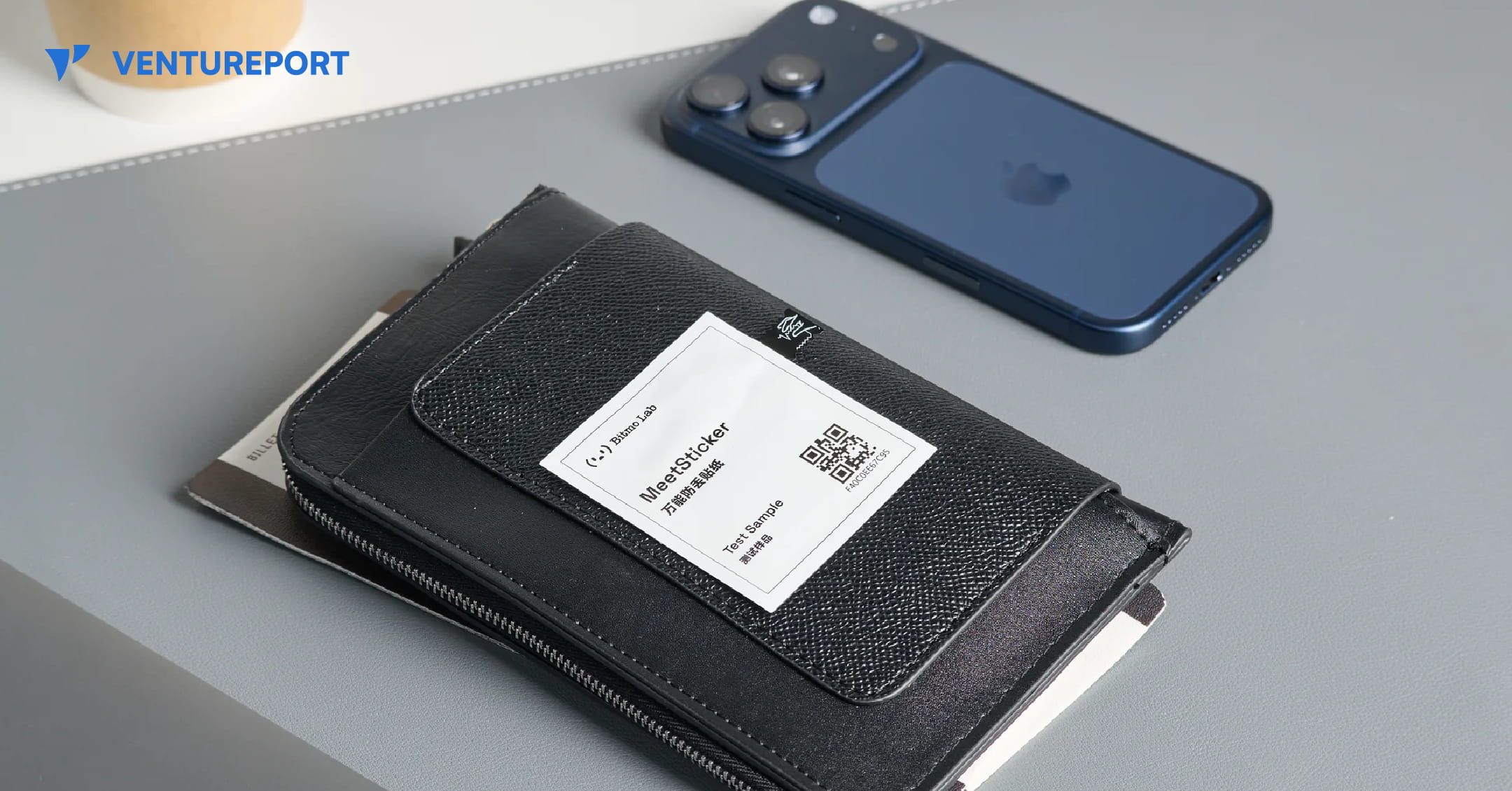
Bitmo Lab's MeetSticker tracker. PHOTO: BITMO LAB
Location trackers have become everyday accessories for keys, bags and luggage. But as personal items grow slimmer and more design-focused — from minimalist wallets to passport sleeves and specialised gear — tracking them has become less straightforward. Most trackers are built as small, rigid discs that assume the presence of space, loops or compartments. That assumption has created a growing mismatch between modern product design and the technology meant to secure it.
Hong Kong–based startup Bitmo Lab is attempting to address that gap with a device called MeetSticker. Instead of the solid plastic casing typical of most trackers, MeetSticker is engineered to be flexible and ultra-thin, measuring just 0.8 millimetres thick. The bendable design allows it to sit within narrow compartments or along curved surfaces without altering the shape of the object. Rather than attaching to an item externally, it is intended to integrate discreetly inside it.
That structural shift is the core of the product’s proposition. By removing the rigid shell that defines conventional tracking hardware, MeetSticker can be placed in items that previously had no practical way to accommodate a tracker. Bitmo Lab states that the device connects through a proprietary network and a companion application compatible with both iOS and Android, positioning it as a cross-platform solution rather than one tied to a single ecosystem.
The implications extend beyond form factor. Objects without obvious attachment points — such as compact travel accessories or specialised tools — could potentially be monitored without visible add-ons. In doing so, the device broadens the scope of tracking technology into categories where aesthetics, aerodynamics or compact design matter as much as functionality.
Before moving toward retail distribution, however, the company is focusing on validation. Bitmo Lab has launched a five-week global alpha testing programme beginning February 9. Sixty participants will receive a prototype unit and early access to the app. According to the company, the programme is designed to assess durability, usability and real-world performance before a wider commercial release. Participants who provide feedback will receive a retail unit upon launch.
Such testing is particularly relevant for flexible electronics. Unlike rigid devices, bendable hardware must withstand repeated flexing, daily handling and environmental exposure. Early user data can help refine manufacturing processes and software optimisation before scaling production.
As with other connected tracking devices, privacy considerations remain part of the equation. Bitmo Lab has stated that data collected during the alpha programme will be used strictly for testing purposes and deleted once the programme concludes.
Whether flexible trackers will redefine the category will depend on how they perform outside controlled testing environments. Still, the introduction of a near-invisible, bendable tracking device reflects a broader shift in consumer technology. As everyday products become thinner and more design-conscious, the tools built to protect them may need to adapt just as seamlessly.