
A humanoid robot being escorted away by police in Macau has gone viral online, prompting jokes about what some called the world’s first “robot arrest.”
Updated
March 13, 2026 2:04 PM
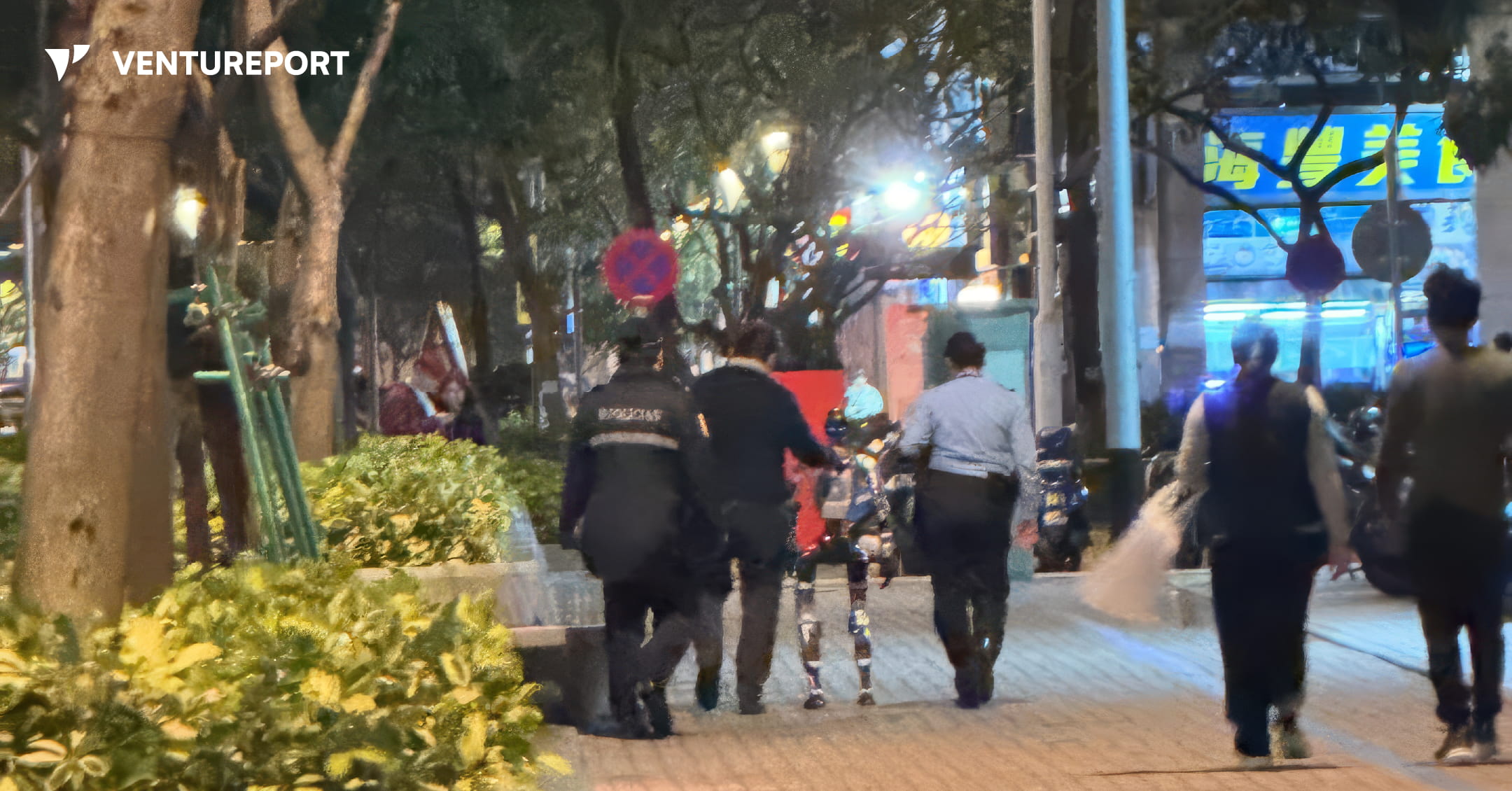
Macau police officer accompanying the humanoid robot. PHOTO: THREADS@BOXOF_CHOCOLATE
Police in Macau recently detained a humanoid robot after it frightened an elderly woman on a public street. The unusual encounter quickly spread online, prompting jokes about what some called the world’s first “robot arrest”.
On the evening of March 5, the robot was taken away by officers after the encounter triggered alarm among bystanders. Videos circulating on social media show an elderly woman confronting the robot on a sidewalk, visibly distressed and shouting that her “heart is pounding” while demanding to know why such “nonsense” was happening on the street. In the clip, the robot raises both hands toward the woman after she lashes out in fear — a gesture many viewers interpreted as a sign of apology.
Shortly afterwards, two officers from the Macau Public Security Police Force were seen escorting the robot and a man believed to be its operator away from the area. An officer is seen placing his right hand on the robot’s shoulder — the same posture police often use when presenting arrested suspects in official photographs.
That scene quickly spread online, fuelling jokes about what some called the world’s first “robot arrest”.
Photos shared online show a humanoid robot with long limbs and exposed mechanical joints, built from a black metallic frame without an outer shell. In dim lighting, several commenters said it resembled a “moving skeleton” — a striking sight for pedestrians encountering it unexpectedly on the street.
Witnesses said the woman appeared severely shaken and an ambulance was eventually called to take her to the hospital.
The incident also sparked discussion online about robots operating in public spaces. Some commenters argued that experimental technologies should be tested in controlled environments, while others said machines moving through public areas should have clearer designs or safety measures to avoid alarming pedestrians.
It remains unclear who deployed the robot or what purpose it was serving in the area at the time of the incident. Authorities have not released further details about the device or whether any action was taken following the encounter.
Keep Reading
A Massachusetts startup advances scalable light-control tech for AR, AI and imaging markets
Updated
February 27, 2026 3:59 PM

Myrias Optics' Nanoimprinted All-inorganic Metaoptic. PHOTO: MYRIAS OPTICS
Myrias Optics, a Massachusetts-based optical technology startup, has raised US$2.1 million in a Seed 1 financing round to accelerate the commercialization of its advanced light-control technology. The round was led by MassVentures, with participation from existing investors Hoss Investment Inc., Maroon Venture Partners and Tenon Venture Partners, as well as new investors Mill Town Capital, TiE Boston Angels and Doug Crane. This new round follows a US$3.3 million seed financing completed in December 2023, led by Asia Optical, and a US$1.5 million Direct-to-Phase II award from the National Science Foundation. In total, Myrias has secured US$6.9 million to date, positioning it to move from development to scaled production.
The company builds ultra-thin, nano-patterned surfaces that precisely control how light moves through a device. These structures replace or enhance traditional lenses and optical parts inside products such as augmented reality headsets, AI data center hardware, consumer electronics, industrial systems and medical imaging devices. The goal is straightforward: to deliver high optical performance while making the parts easier and more cost-effective to manufacture in large quantities.
Across industries such as augmented reality and AI infrastructure, manufacturers face a common challenge. They need highly precise light-guiding components that can withstand heat and long-term use. At the same time, those components must be produced consistently and at scale. Traditional semiconductor-style fabrication can be costly, while polymer-based optical manufacturing can face limits in durability and thermal stability.
Myrias addresses this gap by using inorganic materials and a nanoimprint manufacturing process to create stable, repeatable optical layers on wafers. This approach is designed to combine performance with manufacturability. In augmented reality systems, for example, the company’s technology enables higher viewing angles while remaining suitable for volume production. In AI data centers, the same material and process advantages support improved light transfer and stronger performance under demanding thermal conditions. These benefits also extend to advanced imaging systems in consumer, industrial and medical markets.
The new Seed 1 funding is intended to expand manufacturing capacity and scale pilot production lines. The company will also continue executing active customer programs. Myrias is already working with strategic partners and Tier 1 supply chain participants to integrate its waveguide and light-shaping solutions into commercial AR platforms, AI photonics systems and advanced imaging products. The capital, therefore, supports a clear next step: moving from validated prototypes to a steady commercial supply.