
A humanoid robot being escorted away by police in Macau has gone viral online, prompting jokes about what some called the world’s first “robot arrest.”
Updated
March 17, 2026 12:53 AM
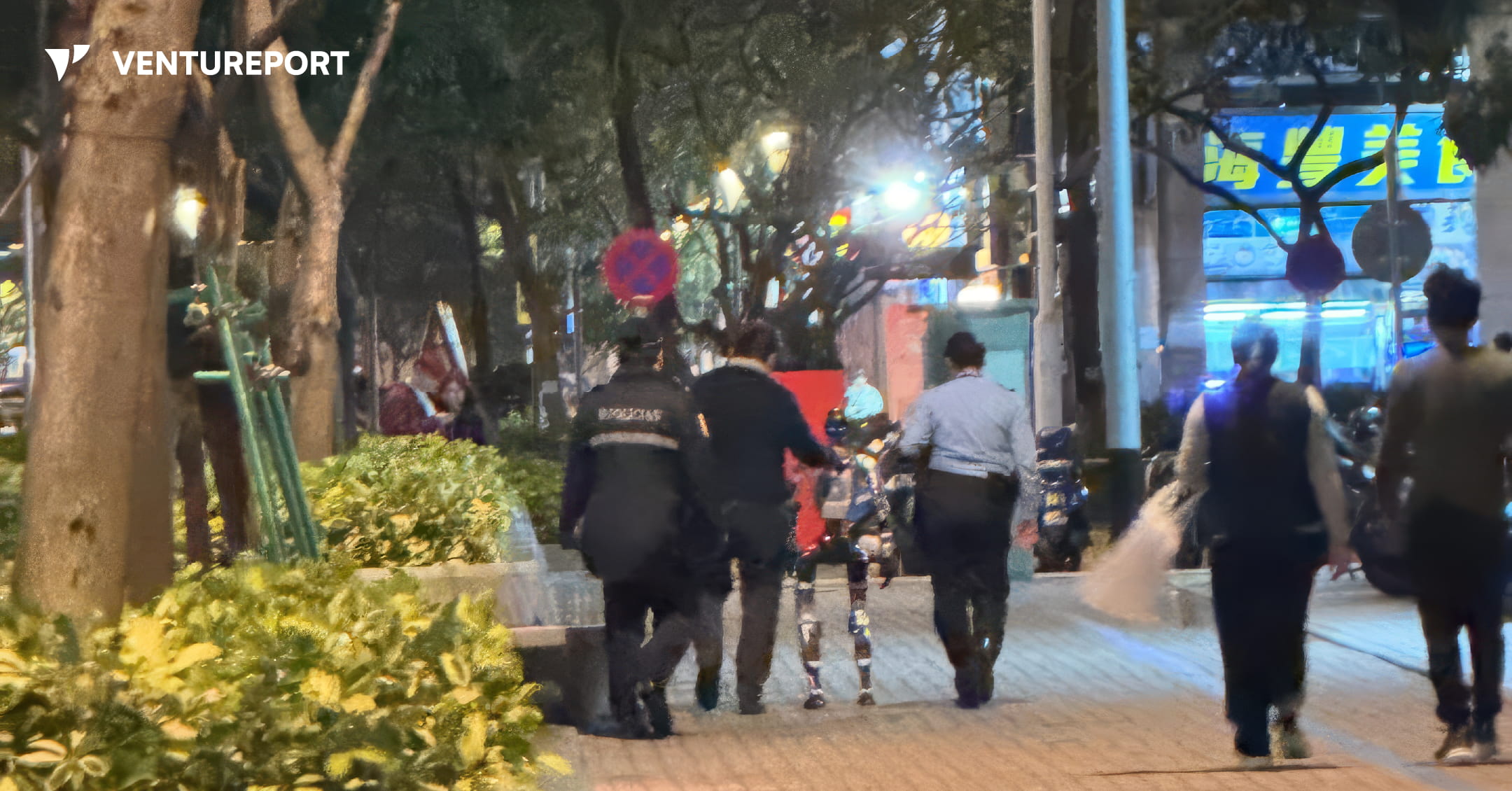
Macau police officer accompanying the humanoid robot. PHOTO: THREADS@BOXOF_CHOCOLATE
Police in Macau recently detained a humanoid robot after it frightened an elderly woman on a public street. The unusual encounter quickly spread online, prompting jokes about what some called the world’s first “robot arrest”.
On the evening of March 5, the robot was taken away by officers after the encounter triggered alarm among bystanders. Videos circulating on social media show an elderly woman confronting the robot on a sidewalk, visibly distressed and shouting that her “heart is pounding” while demanding to know why such “nonsense” was happening on the street. In the clip, the robot raises both hands toward the woman after she lashes out in fear — a gesture many viewers interpreted as a sign of apology.
Shortly afterwards, two officers from the Macau Public Security Police Force were seen escorting the robot and a man believed to be its operator away from the area. An officer is seen placing his right hand on the robot’s shoulder — the same posture police often use when presenting arrested suspects in official photographs.
That scene quickly spread online, fuelling jokes about what some called the world’s first “robot arrest”.
Photos shared online show a humanoid robot with long limbs and exposed mechanical joints, built from a black metallic frame without an outer shell. In dim lighting, several commenters said it resembled a “moving skeleton” — a striking sight for pedestrians encountering it unexpectedly on the street.
Witnesses said the woman appeared severely shaken and an ambulance was eventually called to take her to the hospital.
The incident also sparked discussion online about robots operating in public spaces. Some commenters argued that experimental technologies should be tested in controlled environments, while others said machines moving through public areas should have clearer designs or safety measures to avoid alarming pedestrians.
It remains unclear who deployed the robot or what purpose it was serving in the area at the time of the incident. Authorities have not released further details about the device or whether any action was taken following the encounter.
Keep Reading
Reimagining biodefense at the intersection of AI, biology and urgency.
Updated
January 8, 2026 6:34 PM

Through computational tools, Valthos analyzes biological data to design adaptive solutions against emerging threats. PHOTO: VALTHOS
Valthos has raised US$30 million in seed funding, led by the OpenAI Startup Fund, Lux Capital and Founders Fund, to advance its mission of building next-generation biodefense systems.
The company’s work comes at a time when biotechnology is evolving at an unprecedented pace. Biotechnology is moving at record speed. These new tools can lead to life-changing medical discoveries, but they also bring the risk of dangerous biological agents being developed faster than ever.
“The issue at the core of biodefense is asymmetry”, said Kathleen McMahon, co-founder of Valthos. “It’s easier to make a pathogen than a cure. We’re building tools to help experts at the frontlines of biodefense move as fast as the threats they face”. The gap Valthos aims to close is between the rapid rise of biological threats and the slower pace of developing cures. Therefore, the company is developing AI systems that can rapidly analyze biological sequences and significantly shorten the time needed to design medical countermeasures.
“In this new world, the only way forward is to be faster. So we set out to build a new tech stack for biodefense”, said Tess van Stekelenburg, co-founder of Valthos. “This software infrastructure strengthens biodefense today and lays the groundwork for the adaptive, precision therapeutics of tomorrow”.
The company was founded by van Stekelenburg, a partner at Lux Capital and McMahon, the former head of Palantir’s Life Sciences division. Together, they’ve built a multidisciplinary team of experts from Palantir, DeepMind, Stanford’s Arc Institute and MIT’s Broad Institute, bringing together deep experience in software engineering, machine learning and biotechnology.
“Technology is moving fast. An industrial ecosystem of builders, companies and solutions further democratizes AI to provide broad resilience, and ensures the U.S. continues to lead as AI increasingly powers everything around us. As AI and biotech rapidly advance, biodefense is one of the new industry verticals that helps maximize the benefits and minimize the risks”, said Jason Kwon, OpenAI’s Chief Strategy Officer. “Valthos is pushing the frontier of protection and defense in one of the most strategic intersections of multiple world-changing technologies, and with the team to do it”.
Looking ahead, Valthos plans to expand its engineering team and scale its software infrastructure for both government and commercial partners — moving closer to its goal of enabling faster, smarter and more adaptive biodefense capabilities.