
A humanoid robot being escorted away by police in Macau has gone viral online, prompting jokes about what some called the world’s first “robot arrest.”
Updated
March 17, 2026 12:53 AM
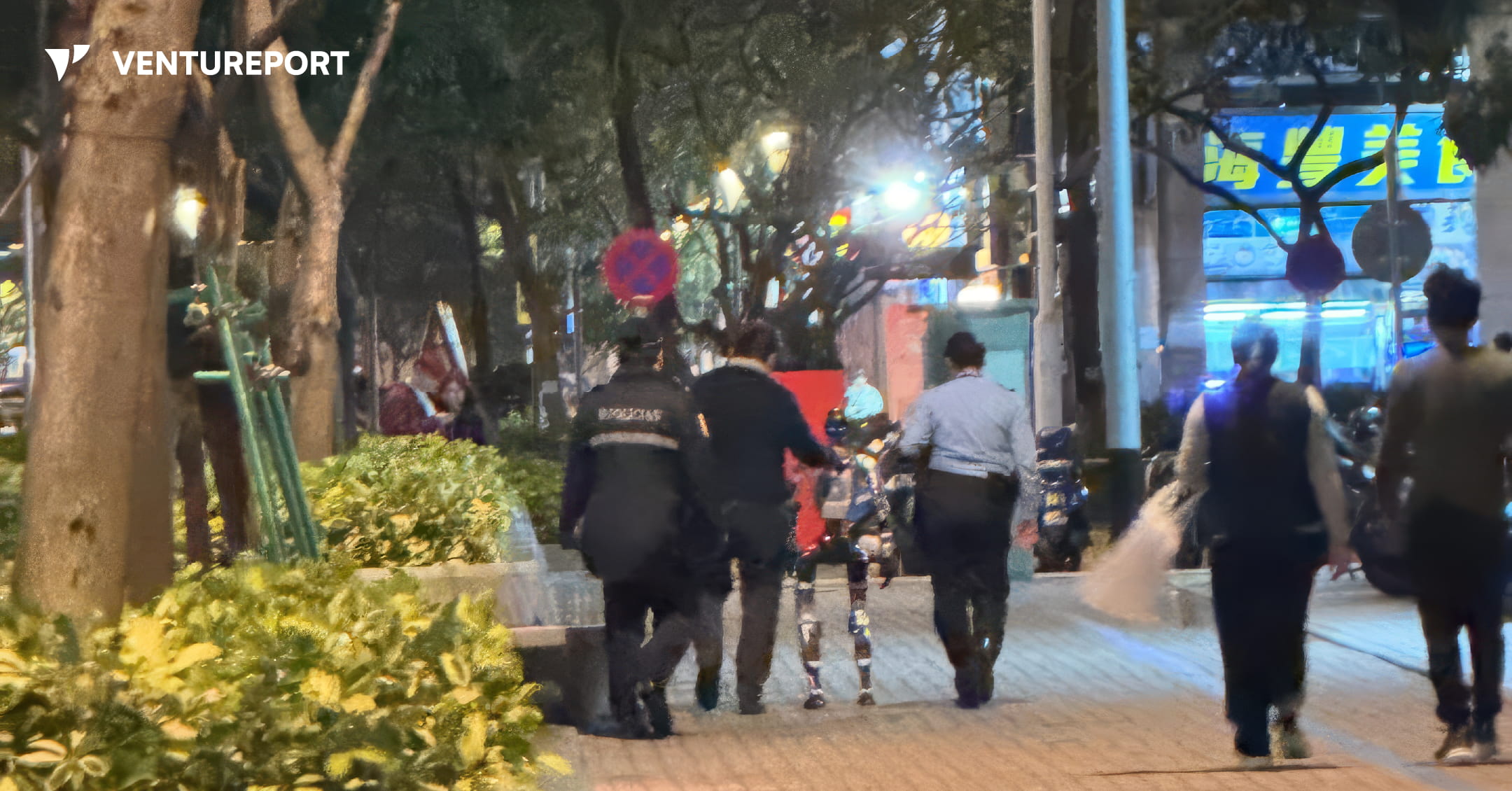
Macau police officer accompanying the humanoid robot. PHOTO: THREADS@BOXOF_CHOCOLATE
Police in Macau recently detained a humanoid robot after it frightened an elderly woman on a public street. The unusual encounter quickly spread online, prompting jokes about what some called the world’s first “robot arrest”.
On the evening of March 5, the robot was taken away by officers after the encounter triggered alarm among bystanders. Videos circulating on social media show an elderly woman confronting the robot on a sidewalk, visibly distressed and shouting that her “heart is pounding” while demanding to know why such “nonsense” was happening on the street. In the clip, the robot raises both hands toward the woman after she lashes out in fear — a gesture many viewers interpreted as a sign of apology.
Shortly afterwards, two officers from the Macau Public Security Police Force were seen escorting the robot and a man believed to be its operator away from the area. An officer is seen placing his right hand on the robot’s shoulder — the same posture police often use when presenting arrested suspects in official photographs.
That scene quickly spread online, fuelling jokes about what some called the world’s first “robot arrest”.
Photos shared online show a humanoid robot with long limbs and exposed mechanical joints, built from a black metallic frame without an outer shell. In dim lighting, several commenters said it resembled a “moving skeleton” — a striking sight for pedestrians encountering it unexpectedly on the street.
Witnesses said the woman appeared severely shaken and an ambulance was eventually called to take her to the hospital.
The incident also sparked discussion online about robots operating in public spaces. Some commenters argued that experimental technologies should be tested in controlled environments, while others said machines moving through public areas should have clearer designs or safety measures to avoid alarming pedestrians.
It remains unclear who deployed the robot or what purpose it was serving in the area at the time of the incident. Authorities have not released further details about the device or whether any action was taken following the encounter.
Keep Reading
Tencent’s latest solution simplifies cross-border payments for Weixin users and merchants.
Updated
January 8, 2026 6:33 PM

Tencent's large penguin statue in front of a building. PHOTO: UNSPLASH
In a world where digital borders are fading faster than ever, Tencent is betting on familiarity. With the launch of TenPay Global Checkout, the company wants to make paying across countries feel as seamless as paying at home.
The new service, unveiled today, allows Weixin Mini Program merchants outside mainland China to accept a variety of local payment methods. That includes digital wallets, real-time payment networks and credit and debit cards, all through a single integration. The launch starts in Singapore and Macao SAR, where merchants can now take payments via PayNow, BOCPAY(MO), and major cards. Japan, Australia and New Zealand are next, with more regions to follow soon.
This rollout builds on the growing reach of Weixin Mini Programs, known internationally through WeChat. These small apps are built right into the platform, letting users' shop, book services and make payments without downloading separate apps. Today, there are over one million monthly active users in key overseas markets, with Mini Programs available across 92 countries and regions.
Yet, for many users abroad, paying within Mini Programs hasn’t always been simple. Foreign card restrictions, currency conversions and limited local options often made checkout a frustrating step. TenPay Global Checkout aims to change that.
“TenPay Global Checkout marks an important step in enhancing the local consumer experience. By enabling overseas Weixin Mini Program merchants to accept trusted and diversified local payment methods through one unified solution, users benefit from a more convenient and efficient payment experience. This helps merchants improve payment conversion rates, expand their user base and scale their businesses to serve a broader range of customers”, said Wenhui Yang, CEO of TenPay Global (Singapore).
What makes this move interesting isn’t just its technical simplicity—it’s the cultural bridge it builds. For users in Singapore or Japan, paying with PayNow or a local card inside Weixin feels less like an international transaction and more like an everyday purchase.
For merchants, it’s an invitation into a market that values convenience and trust. Payment familiarity, after all, often decides whether a user completes a purchase or abandons it at checkout.
The company remains focused on creating secure, connected and user-friendly payment experiences that help merchants grow and allow consumers to pay with confidence, wherever they are.
If successful, TenPay Global Checkout could quietly redefine how cross-border commerce feels—not like a transaction across regions, but a familiar tap, scan or click. In an increasingly global marketplace, that kind of familiarity might just be the next frontier in digital trust.