
A humanoid robot being escorted away by police in Macau has gone viral online, prompting jokes about what some called the world’s first “robot arrest.”
Updated
March 17, 2026 12:53 AM
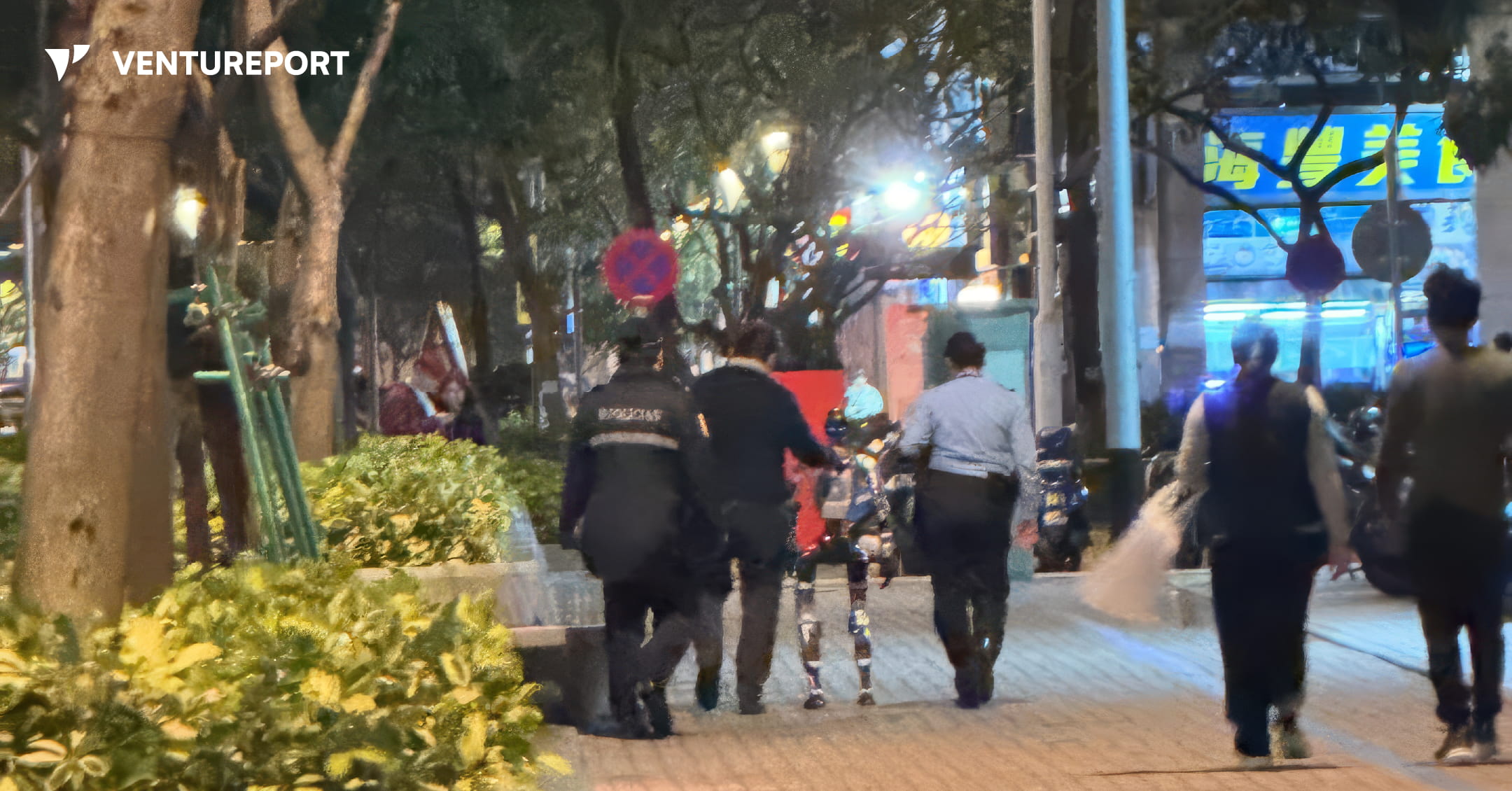
Macau police officer accompanying the humanoid robot. PHOTO: THREADS@BOXOF_CHOCOLATE
Police in Macau recently detained a humanoid robot after it frightened an elderly woman on a public street. The unusual encounter quickly spread online, prompting jokes about what some called the world’s first “robot arrest”.
On the evening of March 5, the robot was taken away by officers after the encounter triggered alarm among bystanders. Videos circulating on social media show an elderly woman confronting the robot on a sidewalk, visibly distressed and shouting that her “heart is pounding” while demanding to know why such “nonsense” was happening on the street. In the clip, the robot raises both hands toward the woman after she lashes out in fear — a gesture many viewers interpreted as a sign of apology.
Shortly afterwards, two officers from the Macau Public Security Police Force were seen escorting the robot and a man believed to be its operator away from the area. An officer is seen placing his right hand on the robot’s shoulder — the same posture police often use when presenting arrested suspects in official photographs.
That scene quickly spread online, fuelling jokes about what some called the world’s first “robot arrest”.
Photos shared online show a humanoid robot with long limbs and exposed mechanical joints, built from a black metallic frame without an outer shell. In dim lighting, several commenters said it resembled a “moving skeleton” — a striking sight for pedestrians encountering it unexpectedly on the street.
Witnesses said the woman appeared severely shaken and an ambulance was eventually called to take her to the hospital.
The incident also sparked discussion online about robots operating in public spaces. Some commenters argued that experimental technologies should be tested in controlled environments, while others said machines moving through public areas should have clearer designs or safety measures to avoid alarming pedestrians.
It remains unclear who deployed the robot or what purpose it was serving in the area at the time of the incident. Authorities have not released further details about the device or whether any action was taken following the encounter.
Keep Reading
Redefining sensor performance with advanced physical AI and signal processing.
Updated
January 8, 2026 6:32 PM
.jpg)
Robot with human features, equipped with a visual sensor. PHOTO: UNSPLASH
Atomathic, the company once known as Neural Propulsion Systems, is stepping into the spotlight with a bold claim: its new AI platforms can help machines “see the invisible”. With the commercial launch of AIDAR™ and AISIR™, the company says it is opening a new chapter for physical AI, AI sensing and advanced sensor technology across automotive, aviation, defense, robotics and semiconductor manufacturing.
The idea behind these platforms is simple yet ambitious. Machines gather enormous amounts of signal data, yet they still struggle to understand the faint, fast or hidden details that matter most when making decisions. Atomathic says its software closes that gap. By applying AI signal processing directly to raw physical signals, the company aims to help sensors pick up subtle patterns that traditional systems miss, enabling faster reactions and more confident autonomous system performance.
"To realize the promise of physical AI, machines must achieve greater autonomy, precision and real-time decision-making—and Atomathic is defining that future," said Dr. Behrooz Rezvani, Founder and CEO of Atomathic. "We make the invisible visible. Our technology fuses the rigor of mathematics with the power of AI to transform how sensors and machines interact with the world—unlocking capabilities once thought to be theoretical. What can be imagined mathematically can now be realized physically."
This technical shift is powered by Atomathic’s deeper mathematical framework. The core of its approach is a method called hyperdefinition technology, which uses the Atomic Norm and fast computational techniques to map sparse physical signals. In simple terms, it pulls clarity out of chaos. This enables ultra-high-resolution signal visualization in real time—something the company claims has never been achieved at this scale in real-time sensing.
AIDAR and AISIR are already being trialled and integrated across multiple sectors and they’re designed to work with a broad range of hardware. That hardware-agnostic design is poised to matter even more as industries shift toward richer, more detailed sensing. Analysts expect the automotive sensor market to surge in the coming years, with radar imaging, next-gen ADAS systems and high-precision machine perception playing increasingly central roles.
Atomathic’s technology comes from a tight-knit team with deep roots in mathematics, machine intelligence and AI research, drawing talent from institutions such as Caltech, UCLA, Stanford and the Technical University of Munich. After seven years of development, the company is ready to show its progress publicly, starting with demonstrations at CES 2026 in Las Vegas.
Suppose the future of autonomy depends on machines perceiving the world with far greater fidelity. In that case, Atomathic is betting that the next leap forward won’t come from more hardware, but from rethinking the math behind the signal—and redefining what physical AI can do.