
A humanoid robot being escorted away by police in Macau has gone viral online, prompting jokes about what some called the world’s first “robot arrest.”
Updated
March 13, 2026 2:04 PM
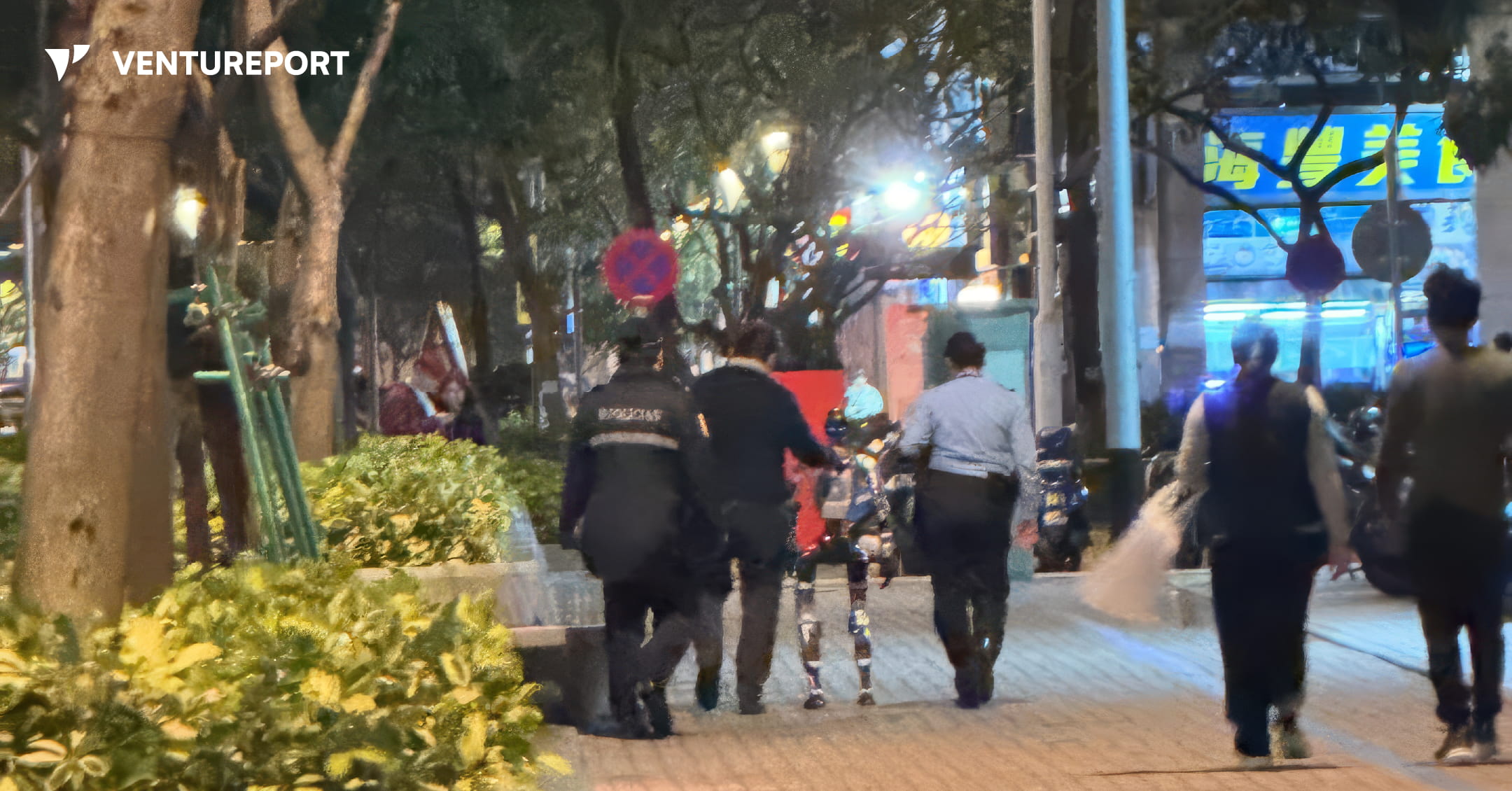
Macau police officer accompanying the humanoid robot. PHOTO: THREADS@BOXOF_CHOCOLATE
Police in Macau recently detained a humanoid robot after it frightened an elderly woman on a public street. The unusual encounter quickly spread online, prompting jokes about what some called the world’s first “robot arrest”.
On the evening of March 5, the robot was taken away by officers after the encounter triggered alarm among bystanders. Videos circulating on social media show an elderly woman confronting the robot on a sidewalk, visibly distressed and shouting that her “heart is pounding” while demanding to know why such “nonsense” was happening on the street. In the clip, the robot raises both hands toward the woman after she lashes out in fear — a gesture many viewers interpreted as a sign of apology.
Shortly afterwards, two officers from the Macau Public Security Police Force were seen escorting the robot and a man believed to be its operator away from the area. An officer is seen placing his right hand on the robot’s shoulder — the same posture police often use when presenting arrested suspects in official photographs.
That scene quickly spread online, fuelling jokes about what some called the world’s first “robot arrest”.
Photos shared online show a humanoid robot with long limbs and exposed mechanical joints, built from a black metallic frame without an outer shell. In dim lighting, several commenters said it resembled a “moving skeleton” — a striking sight for pedestrians encountering it unexpectedly on the street.
Witnesses said the woman appeared severely shaken and an ambulance was eventually called to take her to the hospital.
The incident also sparked discussion online about robots operating in public spaces. Some commenters argued that experimental technologies should be tested in controlled environments, while others said machines moving through public areas should have clearer designs or safety measures to avoid alarming pedestrians.
It remains unclear who deployed the robot or what purpose it was serving in the area at the time of the incident. Authorities have not released further details about the device or whether any action was taken following the encounter.
Keep Reading
Inside Mercuryo’s Visa Partnership
Updated
February 10, 2026 11:18 PM

Close up of Visa credit cards. PHOTO: ADOBE STOCK
Mercuryo is a fintech startup that builds the infrastructure to enable money to move seamlessly between crypto and traditional banking systems. In simple terms, it works on the problem of turning digital assets into usable cash.
As more people hold crypto through wallets and exchanges, one practical issue keeps arising: how do you actually withdraw that money and use it in the real world? For many users, converting tokens into local currency is still slow, confusing or expensive. That gap between “owning” crypto and being able to spend it is where Mercuryo operates.
The company’s latest step forward is a partnership with Visa to improve what is known as “off-ramping” — the process of converting crypto into fiat currency like dollars or euros. Until now, this has often been slow, expensive and confusing for users. Mercuryo is using Visa Direct, Visa’s real-time payments system, to make that process faster and more direct.
With this integration, users can convert their digital tokens into local currency and send the money straight to a Visa debit or credit card. The transaction happens through systems that already power global card payments, which means the money can arrive in near real time instead of days later.
Technically, this connects two very different worlds. On one side is blockchain-based crypto, which moves value on decentralised networks. On the other side is the traditional payment system, which runs on banks, cards and regulated rails. Mercuryo’s platform sits between the two and handles the conversion and movement of funds.
Instead of users leaving their wallet or exchange to cash out, Mercuryo allows the conversion to happen inside the apps and platforms they already use. The user does not need to understand the plumbing behind it. They just see that crypto becomes spendable money on their card.
This matters because access is what makes any financial system usable. If people cannot easily move their money, they treat it as locked or risky. Faster off-ramps make digital assets more practical, not just speculative.
Mercuryo’s work is not about creating new tokens or trading tools. It is about building the pipes that let money move smoothly between Web3 and the traditional financial world. The Visa partnership strengthens those pipes by using a global, trusted payments network that already works at scale.
Visa also framed the partnership as a bridge between systems. Anastasia Serikova, Head of Visa Direct, Europe, said: "By leveraging Visa Direct's capabilities, Mercuryo is not only making converting to fiat faster, simpler and more accessible than ever—it's building bridges between the crypto space and the traditional financial system. This integration empowers users to seamlessly convert digital assets into fiat in near real time, creating a more connected and convenient payment experience".
Over time, this kind of infrastructure is what determines whether crypto remains niche or becomes part of everyday finance. Not through headlines, but through systems that quietly reduce friction.
Mercuryo’s direction is clear: make digital assets easier to use, easier to exit and easier to connect to the money systems people already rely on.