
A humanoid robot being escorted away by police in Macau has gone viral online, prompting jokes about what some called the world’s first “robot arrest.”
Updated
March 13, 2026 2:04 PM
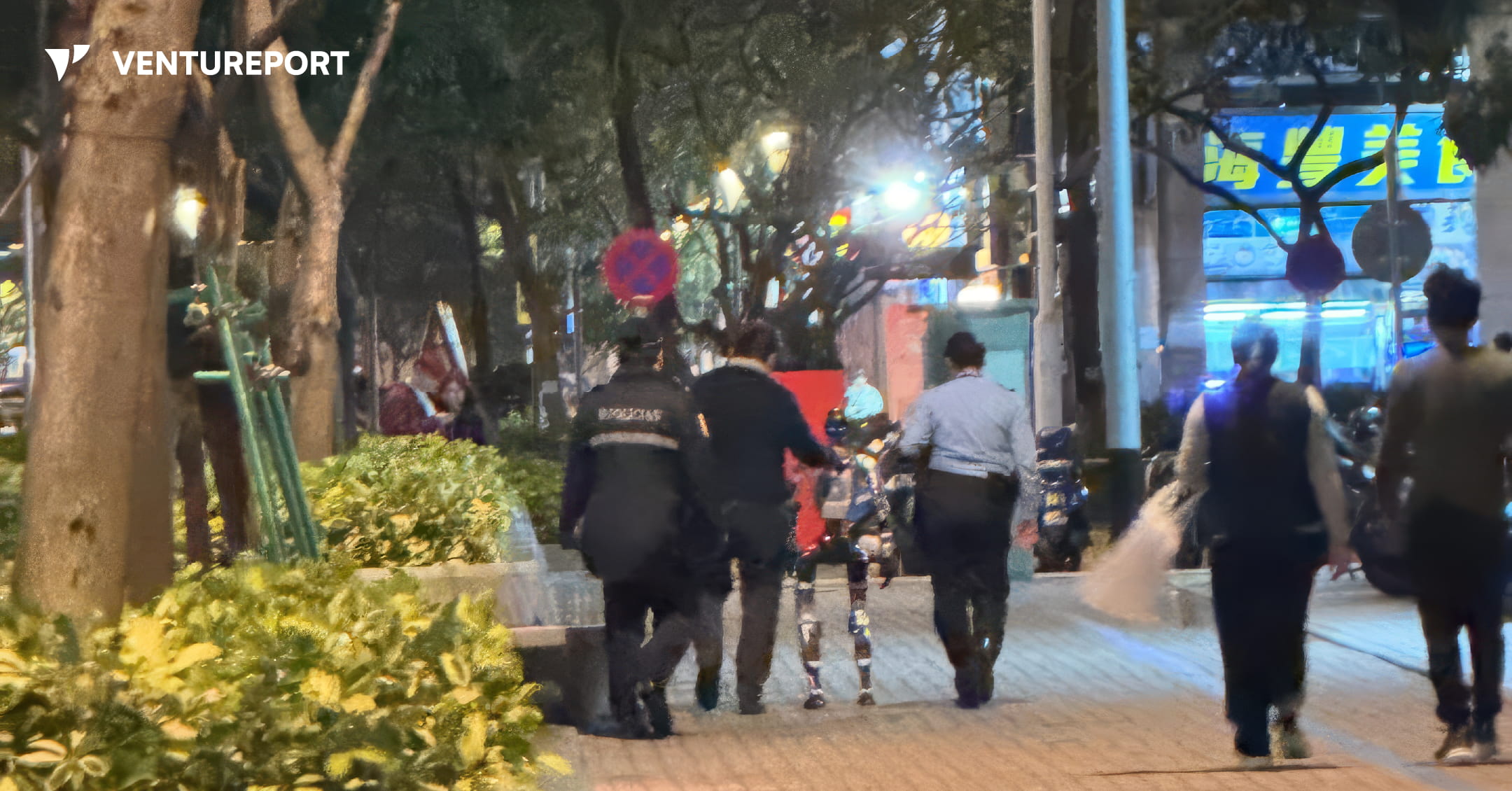
Macau police officer accompanying the humanoid robot. PHOTO: THREADS@BOXOF_CHOCOLATE
Police in Macau recently detained a humanoid robot after it frightened an elderly woman on a public street. The unusual encounter quickly spread online, prompting jokes about what some called the world’s first “robot arrest”.
On the evening of March 5, the robot was taken away by officers after the encounter triggered alarm among bystanders. Videos circulating on social media show an elderly woman confronting the robot on a sidewalk, visibly distressed and shouting that her “heart is pounding” while demanding to know why such “nonsense” was happening on the street. In the clip, the robot raises both hands toward the woman after she lashes out in fear — a gesture many viewers interpreted as a sign of apology.
Shortly afterwards, two officers from the Macau Public Security Police Force were seen escorting the robot and a man believed to be its operator away from the area. An officer is seen placing his right hand on the robot’s shoulder — the same posture police often use when presenting arrested suspects in official photographs.
That scene quickly spread online, fuelling jokes about what some called the world’s first “robot arrest”.
Photos shared online show a humanoid robot with long limbs and exposed mechanical joints, built from a black metallic frame without an outer shell. In dim lighting, several commenters said it resembled a “moving skeleton” — a striking sight for pedestrians encountering it unexpectedly on the street.
Witnesses said the woman appeared severely shaken and an ambulance was eventually called to take her to the hospital.
The incident also sparked discussion online about robots operating in public spaces. Some commenters argued that experimental technologies should be tested in controlled environments, while others said machines moving through public areas should have clearer designs or safety measures to avoid alarming pedestrians.
It remains unclear who deployed the robot or what purpose it was serving in the area at the time of the incident. Authorities have not released further details about the device or whether any action was taken following the encounter.
Keep Reading
A closer look at PMMI’s FastTrack initiative and why it matters for growing manufacturing firms
Updated
February 13, 2026 10:44 AM

Cardboard boxes in a warehouse. PHOTO: UNSPLASH
Large trade shows are built for scale. But for small and medium-sized manufacturers, that scale often creates distance between what’s on display and what they can actually use. Too many options, too little time, and very few tools designed for companies that are still growing. That mismatch is what PMMI is trying to correct with its new SMB FastTrack Program at PACK EXPO East 2026.
That is the problem PMMI is trying to address with its new SMB FastTrack Program, launching at PACK EXPO East 2026 in Philadelphia.
PMMI — the Association for Packaging and Processing Technologies — is the industry body behind the PACK EXPO trade shows and a central organization in the global packaging and processing sector. Through FastTrack, it has created a program (not an app or a product) designed to help small and mid-sized companies navigate the show more efficiently and connect with solutions that fit their scale.
The idea behind SMB FastTrack is simple: reduce friction. Instead of asking smaller firms to sort through hundreds of exhibitors and sessions on their own, the program curates what is most relevant to them. Exhibitors that offer flexible pricing, right-sized machinery, or SMB-focused services are clearly identified with visual icons in both the online directory and on the show floor. That way, a small manufacturer can quickly distinguish between enterprise-only vendors and partners that are realistically accessible.
The same logic carries into education. Rather than treating all attendees the same, PACK EXPO East 2026 will include a learning track specifically built around SMB realities. These sessions focus on issues that smaller teams actually face—how to hire and train workers, use AI without over-investing, improve food safety, cut operating costs, and adopt technology in stages. The goal is not inspiration, but applicability: content that reflects real constraints, not ideal scenarios.
Planning, too, is built into the structure of the program. Through a dedicated FastTrack landing page, participants can access curated supplier lists, recommended sessions, and planning tools that help organize their time before they ever step onto the show floor. Tools like category search and sustainability finders are meant to narrow choices quickly, turning a massive event into something manageable.
Seen together, these elements point to a broader intention. PMMI is not simply adding features—it is reshaping how smaller manufacturers experience a major industry event. Instead of competing for attention in a space built for scale, SMBs are given clearer paths to the people, tools, and knowledge that match where they actually are in their growth cycle.
What makes SMB FastTrack notable is not the technology behind it, but the intention behind it. PMMI is recognizing that progress for small and mid-sized manufacturers depends less on spectacle and more on fit—solutions that are accessible, affordable, and adaptable. The program is designed to help companies move with purpose, not pressure.
In an industry where visibility often follows size, SMB FastTrack represents a structural shift. It treats small and medium-sized manufacturers not as a subset of the audience, but as a distinct group with distinct needs. By doing so, PMMI is quietly redefining what a trade show can be: not just a marketplace of innovation, but a usable platform for companies still building their next stage of growth.