
Where smarter storage meets smarter logistics.
Updated
January 8, 2026 6:32 PM
.jpg)
Kioxia's flagship building at Yokohama Technology Campus. PHOTO: KIOXIA
E-commerce keeps growing and with it, the number of products moving through warehouses every day. Items vary more than ever — different shapes, seasonal packaging, limited editions and constantly updated designs. At the same time, many logistics centers are dealing with labour shortages and rising pressure to automate.
But today’s image-recognition AI isn’t built for this level of change. Most systems rely on deep-learning models that need to be adjusted or retrained whenever new products appear. Every update — whether it’s a new item or a packaging change — adds extra time, energy use and operational cost. And for warehouses handling huge product catalogs, these retraining cycles can slow everything down.
KIOXIA, a company known for its memory and storage technologies, is working on a different approach. In a new collaboration with Tsubakimoto Chain and EAGLYS, the team has developed an AI-based image recognition system that is designed to adapt more easily as product lines grow and shift. The idea is to help logistics sites automatically identify items moving through their workflows without constantly reworking the core AI model.
At the center of the system is KIOXIA’s AiSAQ software paired with its Memory-Centric AI technology. Instead of retraining the model each time new products appear, the system stores new product data — images, labels and feature information — directly in high-capacity storage. This allows warehouses to add new items quickly without altering the original AI model.
Because storing more data can lead to longer search times, the system also indexes the stored product information and transfers the index into SSD storage. This makes it easier for the AI to retrieve relevant features fast, using a Retrieval-Augmented Generation–style method adapted for image recognition.
The collaboration will be showcased at the 2025 International Robot Exhibition in Tokyo. Visitors will see the system classify items in real time as they move along a conveyor, drawing on stored product features to identify them instantly. The demonstration aims to illustrate how logistics sites can handle continuously changing inventories with greater accuracy and reduced friction.
Overall, as logistics networks become increasingly busy and product lines evolve faster than ever, this memory-driven approach provides a practical way to keep automation adaptable and less fragile.
Keep Reading
Bitmo Lab is testing an ultra-thin, bendable tracker built to fit inside items traditional trackers can’t
Updated
February 12, 2026 4:43 PM
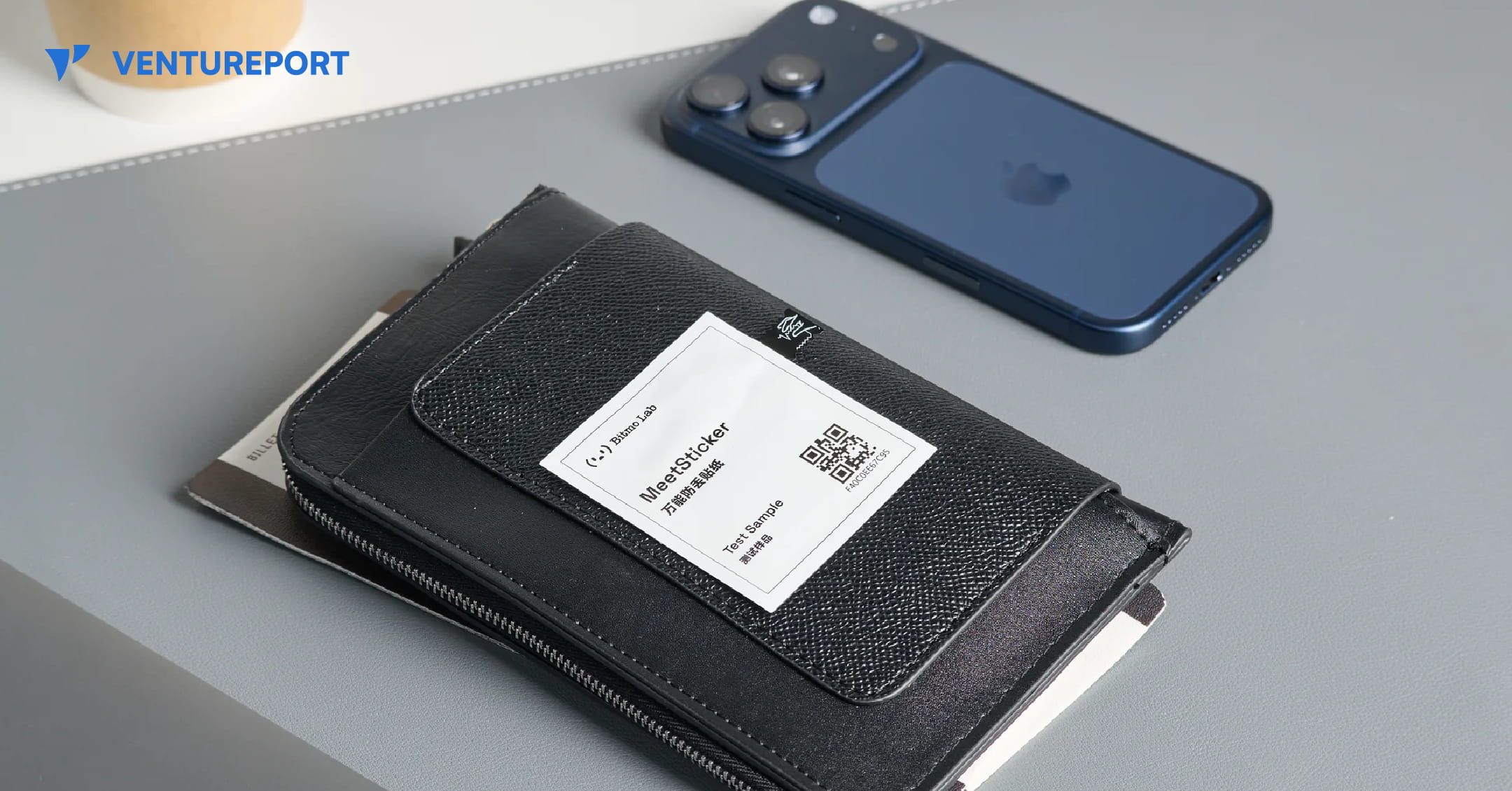
Bitmo Lab's MeetSticker tracker. PHOTO: BITMO LAB
Location trackers have become everyday accessories for keys, bags and luggage. But as personal items grow slimmer and more design-focused — from minimalist wallets to passport sleeves and specialised gear — tracking them has become less straightforward. Most trackers are built as small, rigid discs that assume the presence of space, loops or compartments. That assumption has created a growing mismatch between modern product design and the technology meant to secure it.
Hong Kong–based startup Bitmo Lab is attempting to address that gap with a device called MeetSticker. Instead of the solid plastic casing typical of most trackers, MeetSticker is engineered to be flexible and ultra-thin, measuring just 0.8 millimetres thick. The bendable design allows it to sit within narrow compartments or along curved surfaces without altering the shape of the object. Rather than attaching to an item externally, it is intended to integrate discreetly inside it.
That structural shift is the core of the product’s proposition. By removing the rigid shell that defines conventional tracking hardware, MeetSticker can be placed in items that previously had no practical way to accommodate a tracker. Bitmo Lab states that the device connects through a proprietary network and a companion application compatible with both iOS and Android, positioning it as a cross-platform solution rather than one tied to a single ecosystem.
The implications extend beyond form factor. Objects without obvious attachment points — such as compact travel accessories or specialised tools — could potentially be monitored without visible add-ons. In doing so, the device broadens the scope of tracking technology into categories where aesthetics, aerodynamics or compact design matter as much as functionality.
Before moving toward retail distribution, however, the company is focusing on validation. Bitmo Lab has launched a five-week global alpha testing programme beginning February 9. Sixty participants will receive a prototype unit and early access to the app. According to the company, the programme is designed to assess durability, usability and real-world performance before a wider commercial release. Participants who provide feedback will receive a retail unit upon launch.
Such testing is particularly relevant for flexible electronics. Unlike rigid devices, bendable hardware must withstand repeated flexing, daily handling and environmental exposure. Early user data can help refine manufacturing processes and software optimisation before scaling production.
As with other connected tracking devices, privacy considerations remain part of the equation. Bitmo Lab has stated that data collected during the alpha programme will be used strictly for testing purposes and deleted once the programme concludes.
Whether flexible trackers will redefine the category will depend on how they perform outside controlled testing environments. Still, the introduction of a near-invisible, bendable tracking device reflects a broader shift in consumer technology. As everyday products become thinner and more design-conscious, the tools built to protect them may need to adapt just as seamlessly.