
Examining how robots are moving from demonstrations to daily use.
Updated
January 28, 2026 5:53 PM

An industrial robotic arm capable of autonomous welding. PHOTO: ADOBE STOCK
CES 2026 did not frame robotics as a distant future or a technological spectacle. Instead, it highlighted machines designed for the slow, practical work of fitting into human systems. Across the show floor, robots were no longer performing for attention but being shaped by real-world constraints—space, safety, fatigue and repetition.
They appeared in factories, homes, emergency settings and industrial sites, each responding to a specific kind of human limitation. Together, these four robots reveal how robotics is being redefined: not as a replacement for people, but as infrastructure that quietly takes on work humans are least meant to carry alone.
Hyundai Motor unveiled its electric humanoid robot, Atlas, during a media day on January 5, 2026, at the Mandalay Bay Convention Center in Las Vegas as part of CES 2026. Developed with Boston Dynamics, Hyundai’s U.S.-based robotics subsidiary, Atlas was presented in two forms: a research prototype and a commercial model designed for real factory environments.
Shown under the theme “AI Robotics, Beyond the Lab to Life: Partnering Human Progress,” Atlas is designed to work alongside humans rather than replace them. The premise is straightforward—robots take on physically demanding and repetitive tasks such as sorting and assembly, while people focus on work requiring judgment, creativity and decision-making.
Built for industrial use, the commercial version of Atlas is designed to adapt quickly, with Hyundai stating it can learn new tasks within a day. Its adult-sized humanoid form features 56 degrees of freedom, enabling flexible, human-like movement. Tactile sensors in its hands and a 360-degree vision system support spatial awareness and precise operation.
Atlas is also engineered for demanding conditions. It can lift up to 50 kilograms, operate in temperatures ranging from –20°C to 40°C and is waterproof, making it suitable for challenging factory settings.
Looking ahead, Hyundai expects Atlas to begin with parts sorting and sequencing by 2028, move into assembly by 2030 and later take on precision tasks that require sustained physical effort and focus.
Widemount’s Smart Firefighting Robot is designed to operate in environments that are difficult and dangerous for humans to enter. Developed by Widemount Dynamics, a spinout from the Hong Kong Polytechnic University, the robot is built to support emergency teams during fires, particularly in enclosed and smoke-filled spaces.
The robot can move through buildings and industrial facilities even when visibility is near zero. Rather than relying on cameras or GPS, it uses radar-based mapping to understand its surroundings and determine a safe path forward. This allows it to continue operating when smoke, heat or debris would normally restrict access.
As it approaches a fire, the robot analyses the burning object. Its onboard AI helps identify the material involved and selects an appropriate extinguishing method. Sensors simultaneously assess flame intensity and send real-time updates to command centres, giving responders clearer situational awareness.
When actively fighting a fire, the robot can aim directly at the source and deploy extinguishing agents autonomously. The system continuously adjusts its actions based on incoming sensor data, reducing the need for constant human intervention during high-risk situations.
At CES 2026, LG Electronics offered a glimpse into how household work could gradually shift from people to machines. The company introduced LG CLOiD, an AI-powered home robot designed to manage everyday chores by working directly with connected appliances within LG’s ThinQ ecosystem.
Designed for indoor living spaces, CLOiD features a compact upper body with two articulated arms, a head unit and a wheeled base that enables steady movement across floors. Its torso can tilt to adjust height, allowing it to reach items placed low or on kitchen counters. The arms and hands are built for careful handling, enabling the robot to grip common household objects rather than heavy tools. The head also functions as a mobile control unit, housing cameras, sensors, a display and voice interaction capabilities for communication and monitoring.
In practice, CLOiD acts as a task coordinator. It can retrieve items from appliances, operate ovens and washing machines and manage laundry cycles from start to finish, including folding and stacking clothes. By connecting multiple devices through the ThinQ system, the robot turns separate appliances into a single, coordinated workflow.
These capabilities are supported by LG’s Physical AI system. CLOiD uses vision to recognise objects and interpret its surroundings, language processing to understand instructions and action control to execute tasks step by step. Together, these systems allow the robot to follow routines, respond to user input and adjust task execution over time.
Doosan Robotics introduced Scan & Go at CES 2026, an AI-driven robotic system designed to automate large-scale surface repair and inspection. The solution targets environments with complex, irregular surfaces that are difficult to pre-program, such as aircraft structures, wind turbine blades and large industrial installations.
Scan & Go operates by scanning surfaces on site and building an understanding of their shape in real time. Instead of relying on detailed digital models or manual coding, the system plans its movements based on live data. This enables it to adapt to variations in size, curvature and surface condition without extensive setup.
The underlying technology combines 3D sensing with AI-based motion planning. The system interprets surface data, generates tool paths and refines its actions as work progresses. In practical terms, this reduces manual intervention while maintaining consistency across large work areas.
By handling surface preparation and inspection tasks that are time-consuming and physically demanding, Scan & Go is positioned as a support tool for industrial teams operating at scale.
Taken together, these robots signal a clear shift in how machines are being designed and deployed. Across factories, homes, emergency sites and industrial infrastructure, robotics is moving beyond demonstrations and into practical roles that support human work.
The unifying theme is not replacement, but relief—robots taking on tasks that are repetitive, hazardous or physically demanding. CES 2026 suggests that robotics is evolving from spectacle to utility, with a growing focus on systems that adapt to real environments, respond to genuine constraints and integrate into everyday workflows.
Keep Reading
A new bet on early heart failure detection and why women’s health is at the center.
Updated
January 8, 2026 6:28 PM
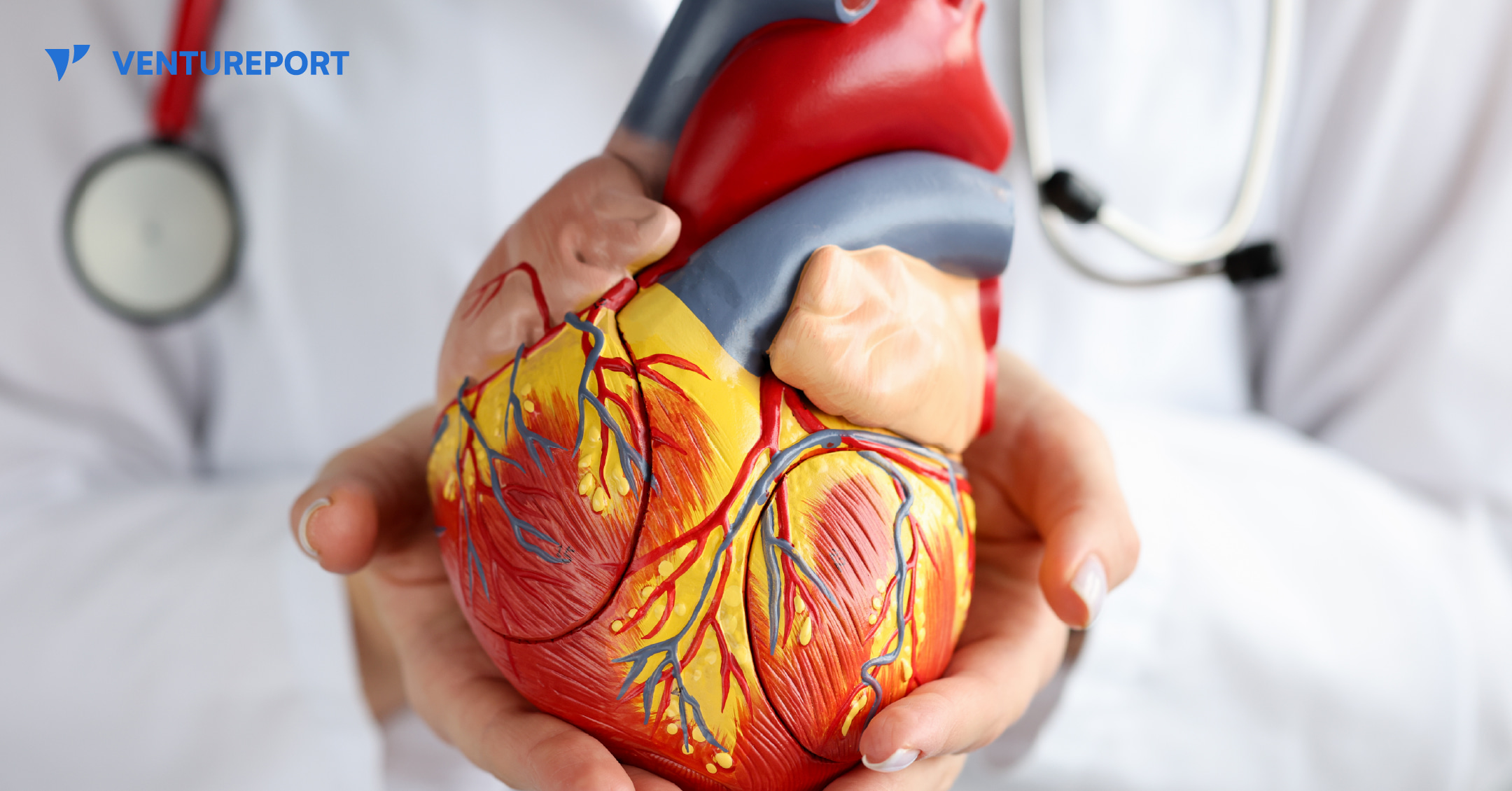
A doctor holding an artificial heart model. PHOTO: ADOBE STOCK
Heart disease does not always announce itself clearly, especially in women. Many of the symptoms are ordinary, including fatigue, shortness of breath and swelling. These signs are frequently dismissed or explained away. As a result, many women are diagnosed late, when treatment options are narrower and outcomes are worse. That diagnostic gap is the context behind a recent investment involving Ultromics and the American Heart Association’s Go Red for Women Venture Fund.
Ultromics is a health technology company that uses artificial intelligence to help doctors spot early signs of heart failure from routine heart scans. It has received a strategic investment from the American Heart Association’s Go Red for Women Venture Fund.
The focus of the investment is a long-standing blind spot in cardiac care. Heart failure with preserved ejection fraction, or HFpEF, affects millions of people worldwide, with women disproportionately impacted. It is one of the most common forms of heart failure, yet also one of the hardest to diagnose. Studies even show women are twice as likely as men to develop the condition and around 64% of cases go undiagnosed in routine clinical practice.
Ultromics works with a tool most patients already experience during heart care: the echocardiogram. There is no new scan and no added burden for patients. Its software analyzes standard heart ultrasound images and looks for subtle patterns that point to early heart failure. The goal is clarity. Give clinicians better signals earlier, before the disease advances.
“Heart failure with preserved ejection fraction is one of the most complex and overlooked diseases in cardiology. For too long, clinicians have been expected to diagnose it using tools that weren't built to detect it and as a result, many patients are identified too late,” said Ross Upton, PhD, CEO and Founder of Ultromics. “By augmenting physicians' decision making with EchoGo, we can help them recognize disease at an earlier stage and treat it more effectively.”
The stakes are high. Research suggests women are twice as likely as men to develop the condition and that a majority of cases are missed in routine clinical practice. That delay matters. New therapies can reduce hospitalizations and improve survival, but only if patients are diagnosed in time.
This is why early detection has become a priority for mission-driven investors. “Closing the diagnostic gap by recognizing disease before irreversible damage occurs is critical to improving health for women—and everyone,” said Tracy Warren, Senior Managing Director, Go Red for Women Venture Fund. “We are gratified to see technologies, such as this one, that are accepted by leading institutions as advances in the field of cardiovascular diagnostics. That's the kind of progress our fund was created to accelerate.”
Ultromics’ platform is already cleared by regulators for clinical use and is being deployed in hospitals across the US and UK. The company says its technology has analyzed hundreds of thousands of heart scans, helping clinicians reach clearer conclusions when traditional methods fall short.
Taken together, the investment reflects a broader shift in healthcare. Attention is shifting earlier—toward detection instead of reaction. Toward tools that fit into existing care rather than complicate it. In this case, the funding is not about introducing something new into the system. It is about seeing what has long been missed—and doing so in time.