
The upgraded CodeFusion Studio 2.0 simplifies how developers design, test and deploy AI on embedded systems.
Updated
January 8, 2026 6:34 PM

Illustration of CodeFusion Studio™ 2.0 showing AI, code and chip icons. PHOTO: ANALOG DEVICES, INC.
Analog Devices (ADI), a global semiconductor company, launched CodeFusion Studio™ 2.0 on November 3, 2025. The new version of its open-source development platform is designed to make it easier and faster for developers to build AI-powered embedded systems that run on ADI’s processors and microcontrollers.
“The next era of embedded intelligence requires removing friction from AI development”, said Rob Oshana, Senior Vice President of the Software and Digital Platforms group at ADI. “CodeFusion Studio 2.0 transforms the developer experience by unifying fragmented AI workflows into a seamless process, empowering developers to leverage the full potential of ADI's cutting-edge products with ease so they can focus on innovating and accelerating time to market”.
The upgraded platform introduces new tools for hardware abstraction, AI integration and automation. These help developers move more easily from early design to deployment.
CodeFusion Studio 2.0 enables complete AI workflows, allowing teams to use their own models and deploy them on everything from low-power edge devices to advanced digital signal processors (DSPs).
Built on Microsoft Visual Studio Code, the new CodeFusion Studio offers built-in checks for model compatibility, along with performance testing and optimization tools that help reduce development time. Building on these capabilities, a new modular framework based on Zephyr OS lets developers test and monitor how AI and machine learning models perform in real time. This gives clearer insight into how each part of a model behaves during operation and helps fine-tune performance across different hardware setups.
Additionally, the CodeFusion Studio System Planner has also been redesigned to handle more device types and complex, multi-core applications. With new built-in diagnostic and debugging features — like integrated memory analysis and visual error tracking — developers can now troubleshoot problems faster and keep their systems running more efficiently.
This launch marks a deeper pivot for ADI. Long known for high-precision analog chips and converters, the company is expanding its edge-AI and software capabilities to enable what it calls Physical Intelligence — systems that can perceive, reason, and act locally.
“Companies that deliver physically aware AI solutions are poised to transform industries and create new, industry-leading opportunities. That's why we're creating an ecosystem that enables developers to optimize, deploy and evaluate AI models seamlessly on ADI hardware, even without physical access to a board”, said Paul Golding, Vice President of Edge AI and Robotics at ADI. “CodeFusion Studio 2.0 is just one step we're taking to deliver Physical Intelligence to our customers, ultimately enabling them to create systems that perceive, reason and act locally, all within the constraints of real-world physics”.
Keep Reading
Bitmo Lab is testing an ultra-thin, bendable tracker built to fit inside items traditional trackers can’t
Updated
February 12, 2026 4:43 PM
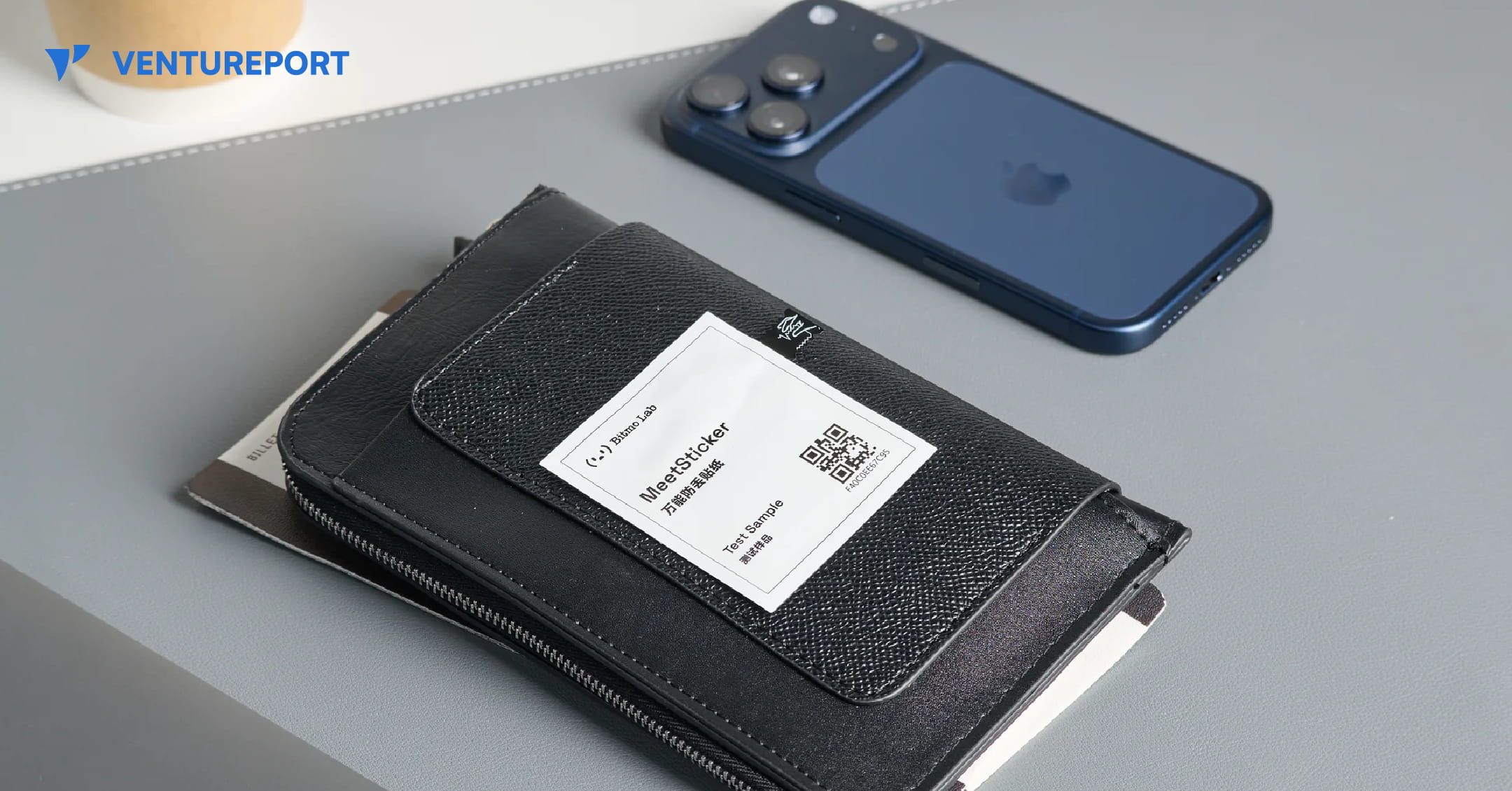
Bitmo Lab's MeetSticker tracker. PHOTO: BITMO LAB
Location trackers have become everyday accessories for keys, bags and luggage. But as personal items grow slimmer and more design-focused — from minimalist wallets to passport sleeves and specialised gear — tracking them has become less straightforward. Most trackers are built as small, rigid discs that assume the presence of space, loops or compartments. That assumption has created a growing mismatch between modern product design and the technology meant to secure it.
Hong Kong–based startup Bitmo Lab is attempting to address that gap with a device called MeetSticker. Instead of the solid plastic casing typical of most trackers, MeetSticker is engineered to be flexible and ultra-thin, measuring just 0.8 millimetres thick. The bendable design allows it to sit within narrow compartments or along curved surfaces without altering the shape of the object. Rather than attaching to an item externally, it is intended to integrate discreetly inside it.
That structural shift is the core of the product’s proposition. By removing the rigid shell that defines conventional tracking hardware, MeetSticker can be placed in items that previously had no practical way to accommodate a tracker. Bitmo Lab states that the device connects through a proprietary network and a companion application compatible with both iOS and Android, positioning it as a cross-platform solution rather than one tied to a single ecosystem.
The implications extend beyond form factor. Objects without obvious attachment points — such as compact travel accessories or specialised tools — could potentially be monitored without visible add-ons. In doing so, the device broadens the scope of tracking technology into categories where aesthetics, aerodynamics or compact design matter as much as functionality.
Before moving toward retail distribution, however, the company is focusing on validation. Bitmo Lab has launched a five-week global alpha testing programme beginning February 9. Sixty participants will receive a prototype unit and early access to the app. According to the company, the programme is designed to assess durability, usability and real-world performance before a wider commercial release. Participants who provide feedback will receive a retail unit upon launch.
Such testing is particularly relevant for flexible electronics. Unlike rigid devices, bendable hardware must withstand repeated flexing, daily handling and environmental exposure. Early user data can help refine manufacturing processes and software optimisation before scaling production.
As with other connected tracking devices, privacy considerations remain part of the equation. Bitmo Lab has stated that data collected during the alpha programme will be used strictly for testing purposes and deleted once the programme concludes.
Whether flexible trackers will redefine the category will depend on how they perform outside controlled testing environments. Still, the introduction of a near-invisible, bendable tracking device reflects a broader shift in consumer technology. As everyday products become thinner and more design-conscious, the tools built to protect them may need to adapt just as seamlessly.