
The upgraded CodeFusion Studio 2.0 simplifies how developers design, test and deploy AI on embedded systems.
Updated
January 8, 2026 6:34 PM

Illustration of CodeFusion Studio™ 2.0 showing AI, code and chip icons. PHOTO: ANALOG DEVICES, INC.
Analog Devices (ADI), a global semiconductor company, launched CodeFusion Studio™ 2.0 on November 3, 2025. The new version of its open-source development platform is designed to make it easier and faster for developers to build AI-powered embedded systems that run on ADI’s processors and microcontrollers.
“The next era of embedded intelligence requires removing friction from AI development”, said Rob Oshana, Senior Vice President of the Software and Digital Platforms group at ADI. “CodeFusion Studio 2.0 transforms the developer experience by unifying fragmented AI workflows into a seamless process, empowering developers to leverage the full potential of ADI's cutting-edge products with ease so they can focus on innovating and accelerating time to market”.
The upgraded platform introduces new tools for hardware abstraction, AI integration and automation. These help developers move more easily from early design to deployment.
CodeFusion Studio 2.0 enables complete AI workflows, allowing teams to use their own models and deploy them on everything from low-power edge devices to advanced digital signal processors (DSPs).
Built on Microsoft Visual Studio Code, the new CodeFusion Studio offers built-in checks for model compatibility, along with performance testing and optimization tools that help reduce development time. Building on these capabilities, a new modular framework based on Zephyr OS lets developers test and monitor how AI and machine learning models perform in real time. This gives clearer insight into how each part of a model behaves during operation and helps fine-tune performance across different hardware setups.
Additionally, the CodeFusion Studio System Planner has also been redesigned to handle more device types and complex, multi-core applications. With new built-in diagnostic and debugging features — like integrated memory analysis and visual error tracking — developers can now troubleshoot problems faster and keep their systems running more efficiently.
This launch marks a deeper pivot for ADI. Long known for high-precision analog chips and converters, the company is expanding its edge-AI and software capabilities to enable what it calls Physical Intelligence — systems that can perceive, reason, and act locally.
“Companies that deliver physically aware AI solutions are poised to transform industries and create new, industry-leading opportunities. That's why we're creating an ecosystem that enables developers to optimize, deploy and evaluate AI models seamlessly on ADI hardware, even without physical access to a board”, said Paul Golding, Vice President of Edge AI and Robotics at ADI. “CodeFusion Studio 2.0 is just one step we're taking to deliver Physical Intelligence to our customers, ultimately enabling them to create systems that perceive, reason and act locally, all within the constraints of real-world physics”.
Keep Reading
The collaboration between Oversonic Robotics and STMicroelectronics highlights how robotics is beginning to fill gaps traditional automation cannot.
Updated
January 23, 2026 10:41 AM
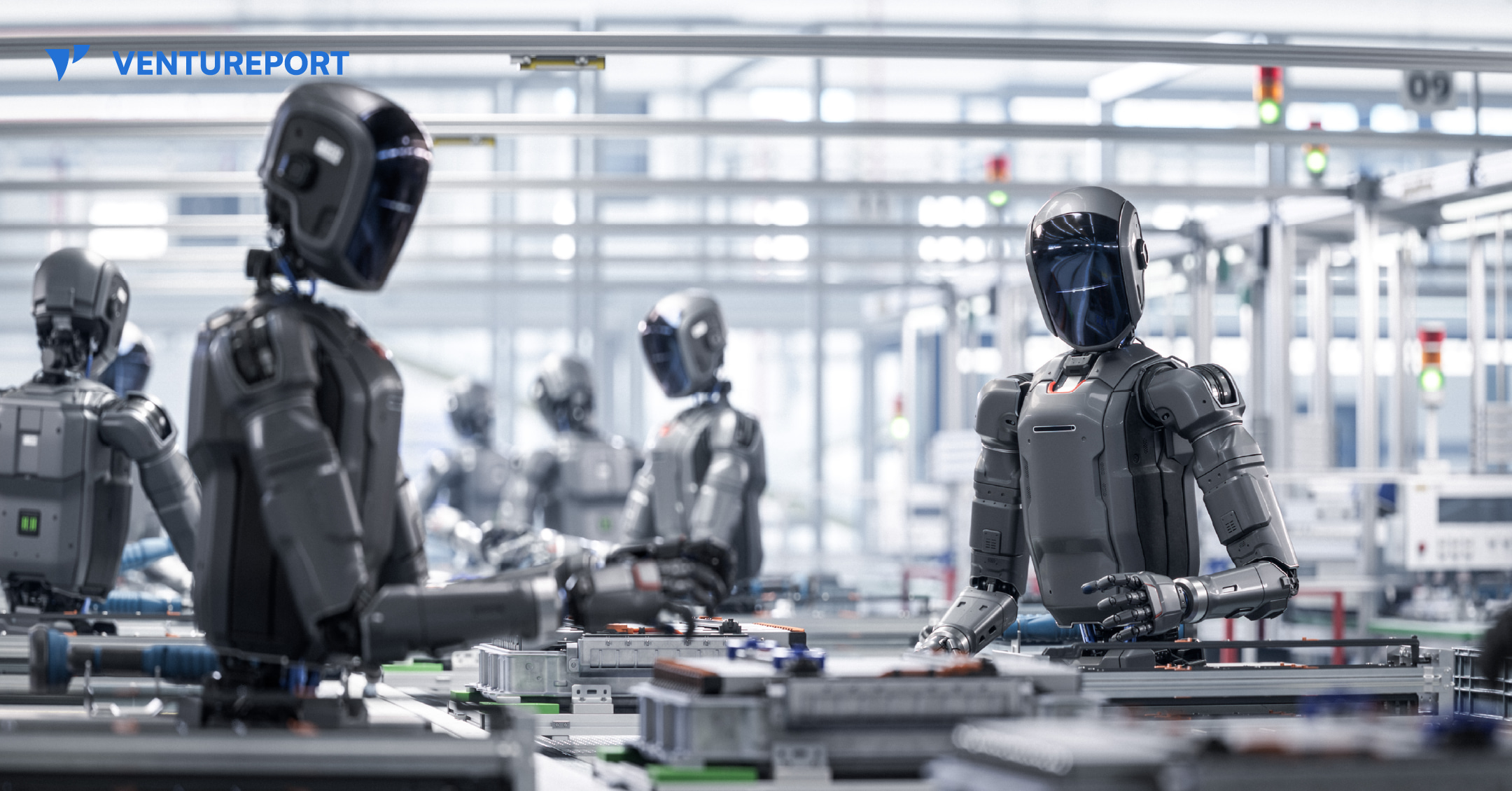
3D render of humanoid robots working in a factory assembly line. PHOTO: ADOBE STOCK
Oversonic Robotics, an Italian company known for building cognitive humanoid robots, has signed an agreement with STMicroelectronics, one of the world’s largest semiconductor manufacturers, to deploy humanoid robots inside semiconductor plants.
According to the companies, this is the first time cognitive humanoid robots will be used operationally inside semiconductor manufacturing facilities. And the first deployment has already taken place at ST’s advanced packaging and test plant in Malta.
At the center of the collaboration is RoBee, Oversonic’s humanoid robot. RoBee is designed to carry out support tasks within industrial environments, particularly where flexibility and interaction with human workers are required. In ST’s factories, the robots will assist with complex manufacturing and logistics flows linked to new semiconductor products. They are intended to work alongside existing automation systems, not replace them.
RoBee is notable for its ability to operate in environments shared with people. It is currently the only humanoid robot certified for use in both industrial and healthcare settings and is already in operation within several Italian companies. The robot is also being used in experimental hospital programs. That background helped position RoBee for deployment in tightly controlled manufacturing environments such as semiconductor plants.
Fabio Puglia, President of Oversonic Robotics, described the agreement as a milestone for deploying humanoid robots in complex industrial settings: “The partnership with STMicroelectronics is a great source of pride for us because it embodies the vision of cognitive robotics that Oversonic has brought to the industrial and healthcare markets. Being the first to introduce cognitive humanoid robots in a sophisticated production context such as semiconductors means measuring ourselves against the highest standards in terms of reliability, safety and operational continuity. This agreement represents a fundamental milestone for Oversonic and, more generally, for the industrial challenges these new machines are called to face in innovative and highly complex environments, alongside people and supporting their quality of work”.
From STMicroelectronics’ side, the use of humanoid robots is framed as part of a broader effort to manage growing manufacturing complexity. he company said RoBee will support complex tasks and help manage the intricate production flows required by newer semiconductor products. It is also expected to contribute to improved product quality and shorter manufacturing cycle times. The robots are designed to integrate with existing automation and software systems, helping improve safety and operational continuity.
In semiconductor manufacturing, precision and reliability leave little room for experimentation. Therefore, introducing humanoid robots into this environment signals a practical shift. It shows how robotics is starting to fill gaps that traditional automation has struggled to address.