
HSUHK’s award-winning system shows how AI, drones and AR can cut training time, reduce errors and reshape warehouse operations
Updated
March 30, 2026 2:29 PM

Dji Mavic Mini 2 drone. PHOTO: ADOBE STOCK
As global tech ecosystems become more interconnected, the ability to move innovation across borders is becoming just as important as building it. A new partnership between MTR Lab, the investment arm of MTR Corporation and ZGC Science City Ltd, a government-backed technology ecosystem based in Beijing’s Haidian district, reflects this shift.
At its core, the collaboration is designed to connect high-potential Chinese startups with global capital, real-world deployment opportunities and international markets. It focuses on sectors like AI, robotics, smart mobility and sustainable urban development—areas where China already has strong technical depth but where scaling beyond domestic markets can be more complex.
This is where the partnership begins to matter. ZGC Science City sits at the center of one of China’s most concentrated innovation clusters, with thousands of AI companies and a growing base of specialised and high-growth firms. MTR Lab, on the other hand, brings access to international markets, industry networks and practical deployment environments tied to infrastructure, transport and urban systems. Together, they are attempting to bridge a familiar gap: turning local innovation into globally relevant products.
In practice, the model is straightforward. ZGC Science City will introduce MTR Lab to startups working in priority sectors, creating a pipeline for potential investment and collaboration. From there, MTR Lab can support these companies through funding, pilot projects and access to overseas markets. The idea is not just to invest, but to help startups test and apply their technologies in real-world settings, particularly in complex urban environments.
The timing is notable. China’s AI and deep tech ecosystem has expanded rapidly, with thousands of companies contributing to advancements in automation, smart infrastructure and sustainability. At the same time, global demand for these technologies is rising, especially as cities look for more efficient and scalable solutions. Yet, moving from innovation to adoption often requires cross-border coordination—something individual startups may struggle to navigate alone.
This partnership also builds on a broader pattern. Corporate venture arms like MTR Lab are increasingly positioning themselves not just as investors, but as connectors between markets. By combining capital with access to infrastructure and deployment scenarios, they offer startups a way to move faster from development to real-world use. For ZGC Science City, the collaboration adds an international layer to its ecosystem, helping local companies extend beyond domestic growth.
What emerges is a model that goes beyond a typical investment announcement. It reflects a growing recognition that innovation today is rarely confined to one geography. Technologies may be developed in one ecosystem, refined in another and scaled globally through partnerships like this.
As cross-border collaboration becomes more central to how startups grow, partnerships like the one between MTR Lab and ZGC Science City point to a more connected innovation landscape—one where access, not just invention, defines success.
Keep Reading
A humanoid robot being escorted away by police in Macau has gone viral online, prompting jokes about what some called the world’s first “robot arrest.”
Updated
March 17, 2026 12:53 AM
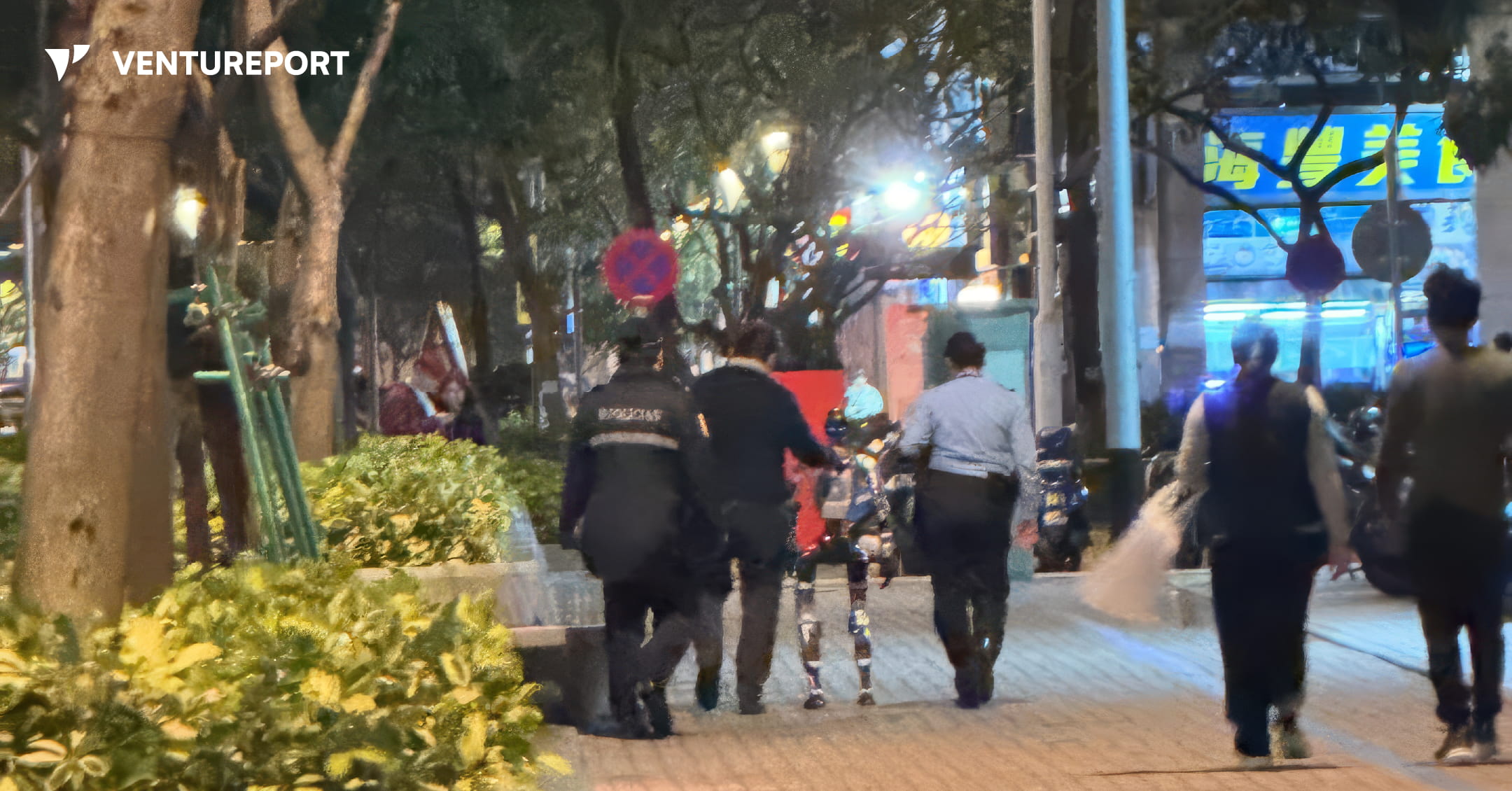
Macau police officer accompanying the humanoid robot. PHOTO: THREADS@BOXOF_CHOCOLATE
Police in Macau recently detained a humanoid robot after it frightened an elderly woman on a public street. The unusual encounter quickly spread online, prompting jokes about what some called the world’s first “robot arrest”.
On the evening of March 5, the robot was taken away by officers after the encounter triggered alarm among bystanders. Videos circulating on social media show an elderly woman confronting the robot on a sidewalk, visibly distressed and shouting that her “heart is pounding” while demanding to know why such “nonsense” was happening on the street. In the clip, the robot raises both hands toward the woman after she lashes out in fear — a gesture many viewers interpreted as a sign of apology.
Shortly afterwards, two officers from the Macau Public Security Police Force were seen escorting the robot and a man believed to be its operator away from the area. An officer is seen placing his right hand on the robot’s shoulder — the same posture police often use when presenting arrested suspects in official photographs.
That scene quickly spread online, fuelling jokes about what some called the world’s first “robot arrest”.
Photos shared online show a humanoid robot with long limbs and exposed mechanical joints, built from a black metallic frame without an outer shell. In dim lighting, several commenters said it resembled a “moving skeleton” — a striking sight for pedestrians encountering it unexpectedly on the street.
Witnesses said the woman appeared severely shaken and an ambulance was eventually called to take her to the hospital.
The incident also sparked discussion online about robots operating in public spaces. Some commenters argued that experimental technologies should be tested in controlled environments, while others said machines moving through public areas should have clearer designs or safety measures to avoid alarming pedestrians.
It remains unclear who deployed the robot or what purpose it was serving in the area at the time of the incident. Authorities have not released further details about the device or whether any action was taken following the encounter.