
Bitmo Lab is testing an ultra-thin, bendable tracker built to fit inside items traditional trackers can’t
Updated
February 12, 2026 4:43 PM
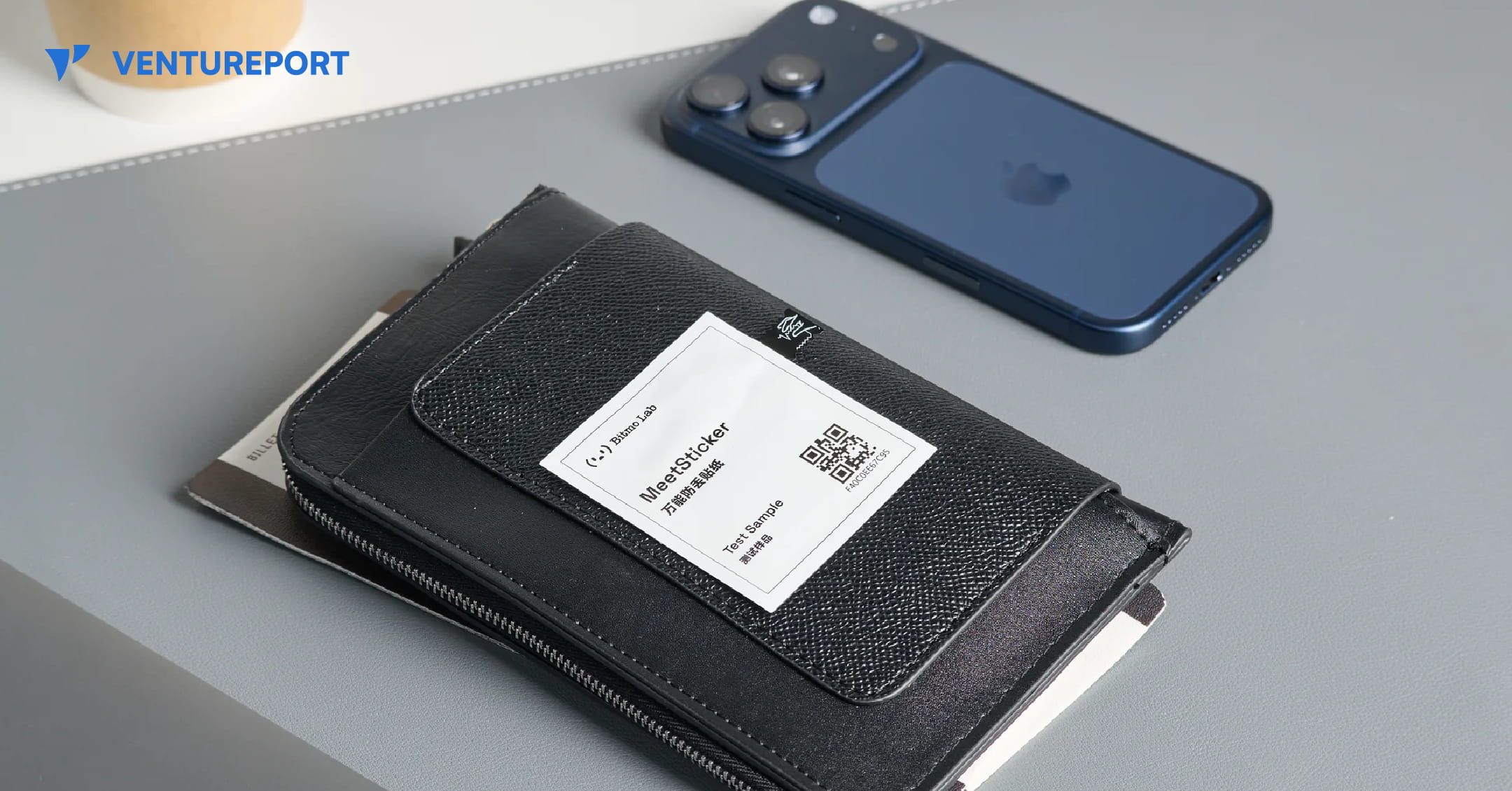
Bitmo Lab's MeetSticker tracker. PHOTO: BITMO LAB
Location trackers have become everyday accessories for keys, bags and luggage. But as personal items grow slimmer and more design-focused — from minimalist wallets to passport sleeves and specialised gear — tracking them has become less straightforward. Most trackers are built as small, rigid discs that assume the presence of space, loops or compartments. That assumption has created a growing mismatch between modern product design and the technology meant to secure it.
Hong Kong–based startup Bitmo Lab is attempting to address that gap with a device called MeetSticker. Instead of the solid plastic casing typical of most trackers, MeetSticker is engineered to be flexible and ultra-thin, measuring just 0.8 millimetres thick. The bendable design allows it to sit within narrow compartments or along curved surfaces without altering the shape of the object. Rather than attaching to an item externally, it is intended to integrate discreetly inside it.
That structural shift is the core of the product’s proposition. By removing the rigid shell that defines conventional tracking hardware, MeetSticker can be placed in items that previously had no practical way to accommodate a tracker. Bitmo Lab states that the device connects through a proprietary network and a companion application compatible with both iOS and Android, positioning it as a cross-platform solution rather than one tied to a single ecosystem.
The implications extend beyond form factor. Objects without obvious attachment points — such as compact travel accessories or specialised tools — could potentially be monitored without visible add-ons. In doing so, the device broadens the scope of tracking technology into categories where aesthetics, aerodynamics or compact design matter as much as functionality.
Before moving toward retail distribution, however, the company is focusing on validation. Bitmo Lab has launched a five-week global alpha testing programme beginning February 9. Sixty participants will receive a prototype unit and early access to the app. According to the company, the programme is designed to assess durability, usability and real-world performance before a wider commercial release. Participants who provide feedback will receive a retail unit upon launch.
Such testing is particularly relevant for flexible electronics. Unlike rigid devices, bendable hardware must withstand repeated flexing, daily handling and environmental exposure. Early user data can help refine manufacturing processes and software optimisation before scaling production.
As with other connected tracking devices, privacy considerations remain part of the equation. Bitmo Lab has stated that data collected during the alpha programme will be used strictly for testing purposes and deleted once the programme concludes.
Whether flexible trackers will redefine the category will depend on how they perform outside controlled testing environments. Still, the introduction of a near-invisible, bendable tracking device reflects a broader shift in consumer technology. As everyday products become thinner and more design-conscious, the tools built to protect them may need to adapt just as seamlessly.
Keep Reading
From information gaps to global access — how AI is reshaping the pursuit of knowledge.
Updated
January 8, 2026 6:33 PM
.jpg)
Paper cut-outs of robots sitting on a pile of books. PHOTO: FREEPIK
Encyclopaedias have always been mirrors of their time — from heavy leather-bound volumes in the 19th century to Wikipedia’s community-edited pages online. But as the world’s information multiplies faster than humans can catalogue it, even open platforms struggle to keep pace. Enter Botipedia, a new project from INSEAD, The Business School for the World, that reimagines how knowledge can be created, verified and shared using artificial intelligence.
At its core, Botipedia is powered by proprietary AI that automates the process of writing encyclopaedia entries. Instead of relying on volunteers or editors, it uses a system called Dynamic Multi-method Generation (DMG) — a method that combines hundreds of algorithms and curated datasets to produce high-quality, verifiable content. This AI doesn’t just summarise what already exists; it synthesises information from archives, satellite feeds and data libraries to generate original text grounded in facts.
What makes this innovation significant is the gap it fills in global access to knowledge. While Wikipedia hosts roughly 64 million English-language entries, languages like Swahili have fewer than 40,000 articles — leaving most of the world’s population outside the circle of easily available online information. Botipedia aims to close that gap by generating over 400 billion entries across 100 languages, ensuring that no subject, event or region is overlooked.
"We are creating Botipedia to provide everyone with equal access to information, with no language left behind", says Phil Parker, INSEAD Chaired Professor of Management Science, creator of Botipedia and holder of one of the pioneering patents in the field of generative AI. "We focus on content grounded in data and sources with full provenance, allowing the user to see as many perspectives as possible, as opposed to one potentially biased source".
Unlike many generative AI tools that depend on large language models (LLMs), Botipedia adapts its methods based on the type of content. For instance, weather data is generated using geo-spatial techniques to cover every possible coordinate on Earth. This targeted, multi-method approach helps boost both the accuracy and reliability of what it produces — key challenges in today’s AI-driven content landscape.
Additionally, the innovation is also energy-efficient. Its DMG system operates at a fraction of the processing power required by GPU-heavy models like ChatGPT, making it a sustainable alternative for large-scale content generation.
By combining AI precision, linguistic inclusivity and academic credibility, Botipedia positions itself as more than a digital library — it’s a step toward universal, unbiased access to verified knowledge.
"Botipedia is one of many initiatives of the Human and Machine Intelligence Institute (HUMII) that we are establishing at INSEAD", says Lily Fang, Dean of Research and Innovation at INSEAD. "It is a practical application that builds on INSEAD-linked IP to help people make better decisions with knowledge powered by technology. We want technologies that enhance the quality and meaning of our work and life, to retain human agency and value in the age of intelligence".
By harnessing AI to bridge gaps of language, geography and credibility, Botipedia points to a future where access to knowledge is no longer a privilege, but a shared global resource.