
Bitmo Lab is testing an ultra-thin, bendable tracker built to fit inside items traditional trackers can’t
Updated
February 12, 2026 4:43 PM
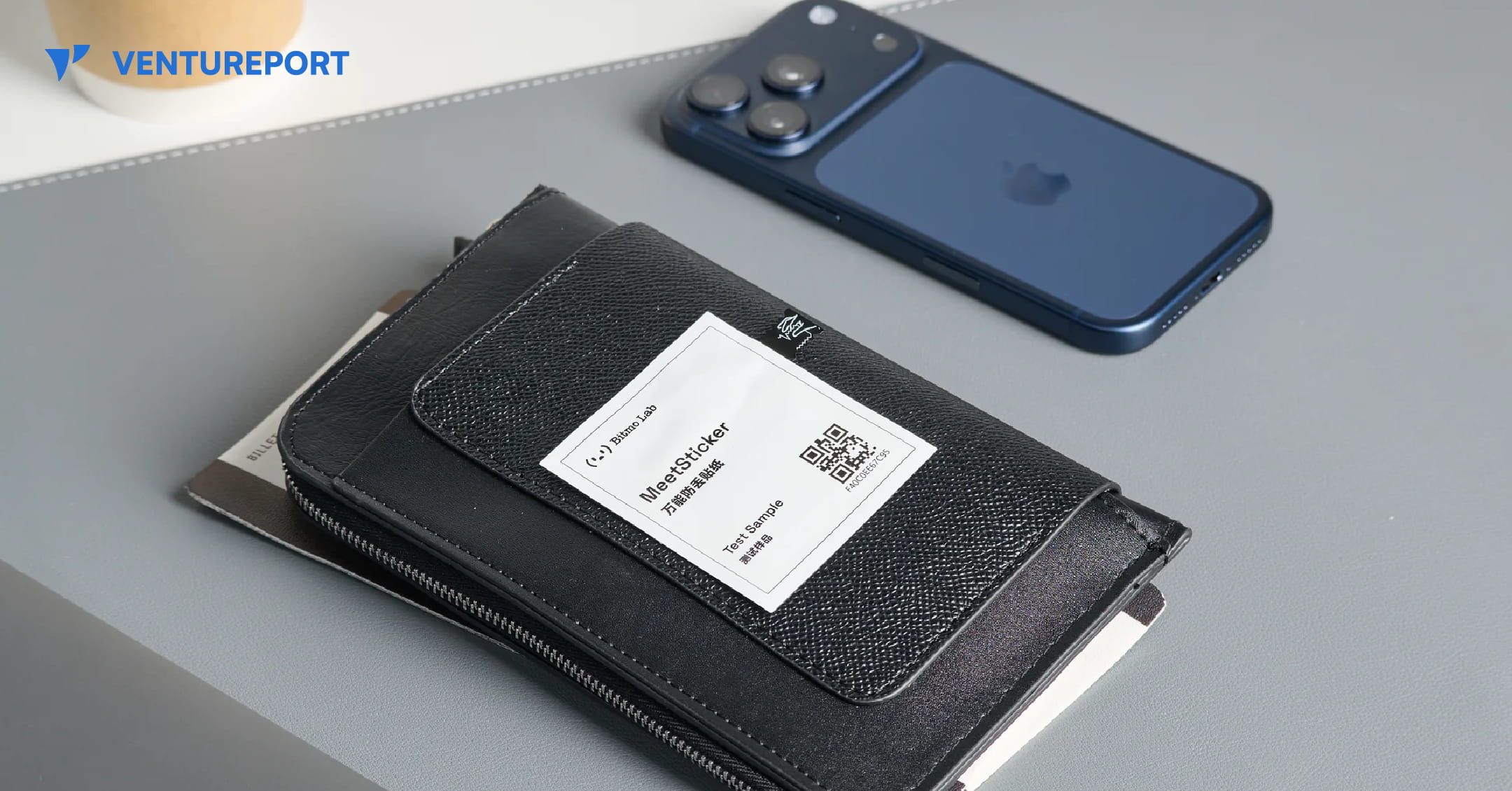
Bitmo Lab's MeetSticker tracker. PHOTO: BITMO LAB
Location trackers have become everyday accessories for keys, bags and luggage. But as personal items grow slimmer and more design-focused — from minimalist wallets to passport sleeves and specialised gear — tracking them has become less straightforward. Most trackers are built as small, rigid discs that assume the presence of space, loops or compartments. That assumption has created a growing mismatch between modern product design and the technology meant to secure it.
Hong Kong–based startup Bitmo Lab is attempting to address that gap with a device called MeetSticker. Instead of the solid plastic casing typical of most trackers, MeetSticker is engineered to be flexible and ultra-thin, measuring just 0.8 millimetres thick. The bendable design allows it to sit within narrow compartments or along curved surfaces without altering the shape of the object. Rather than attaching to an item externally, it is intended to integrate discreetly inside it.
That structural shift is the core of the product’s proposition. By removing the rigid shell that defines conventional tracking hardware, MeetSticker can be placed in items that previously had no practical way to accommodate a tracker. Bitmo Lab states that the device connects through a proprietary network and a companion application compatible with both iOS and Android, positioning it as a cross-platform solution rather than one tied to a single ecosystem.
The implications extend beyond form factor. Objects without obvious attachment points — such as compact travel accessories or specialised tools — could potentially be monitored without visible add-ons. In doing so, the device broadens the scope of tracking technology into categories where aesthetics, aerodynamics or compact design matter as much as functionality.
Before moving toward retail distribution, however, the company is focusing on validation. Bitmo Lab has launched a five-week global alpha testing programme beginning February 9. Sixty participants will receive a prototype unit and early access to the app. According to the company, the programme is designed to assess durability, usability and real-world performance before a wider commercial release. Participants who provide feedback will receive a retail unit upon launch.
Such testing is particularly relevant for flexible electronics. Unlike rigid devices, bendable hardware must withstand repeated flexing, daily handling and environmental exposure. Early user data can help refine manufacturing processes and software optimisation before scaling production.
As with other connected tracking devices, privacy considerations remain part of the equation. Bitmo Lab has stated that data collected during the alpha programme will be used strictly for testing purposes and deleted once the programme concludes.
Whether flexible trackers will redefine the category will depend on how they perform outside controlled testing environments. Still, the introduction of a near-invisible, bendable tracking device reflects a broader shift in consumer technology. As everyday products become thinner and more design-conscious, the tools built to protect them may need to adapt just as seamlessly.
Keep Reading
Redefining sensor performance with advanced physical AI and signal processing.
Updated
January 8, 2026 6:32 PM
.jpg)
Robot with human features, equipped with a visual sensor. PHOTO: UNSPLASH
Atomathic, the company once known as Neural Propulsion Systems, is stepping into the spotlight with a bold claim: its new AI platforms can help machines “see the invisible”. With the commercial launch of AIDAR™ and AISIR™, the company says it is opening a new chapter for physical AI, AI sensing and advanced sensor technology across automotive, aviation, defense, robotics and semiconductor manufacturing.
The idea behind these platforms is simple yet ambitious. Machines gather enormous amounts of signal data, yet they still struggle to understand the faint, fast or hidden details that matter most when making decisions. Atomathic says its software closes that gap. By applying AI signal processing directly to raw physical signals, the company aims to help sensors pick up subtle patterns that traditional systems miss, enabling faster reactions and more confident autonomous system performance.
"To realize the promise of physical AI, machines must achieve greater autonomy, precision and real-time decision-making—and Atomathic is defining that future," said Dr. Behrooz Rezvani, Founder and CEO of Atomathic. "We make the invisible visible. Our technology fuses the rigor of mathematics with the power of AI to transform how sensors and machines interact with the world—unlocking capabilities once thought to be theoretical. What can be imagined mathematically can now be realized physically."
This technical shift is powered by Atomathic’s deeper mathematical framework. The core of its approach is a method called hyperdefinition technology, which uses the Atomic Norm and fast computational techniques to map sparse physical signals. In simple terms, it pulls clarity out of chaos. This enables ultra-high-resolution signal visualization in real time—something the company claims has never been achieved at this scale in real-time sensing.
AIDAR and AISIR are already being trialled and integrated across multiple sectors and they’re designed to work with a broad range of hardware. That hardware-agnostic design is poised to matter even more as industries shift toward richer, more detailed sensing. Analysts expect the automotive sensor market to surge in the coming years, with radar imaging, next-gen ADAS systems and high-precision machine perception playing increasingly central roles.
Atomathic’s technology comes from a tight-knit team with deep roots in mathematics, machine intelligence and AI research, drawing talent from institutions such as Caltech, UCLA, Stanford and the Technical University of Munich. After seven years of development, the company is ready to show its progress publicly, starting with demonstrations at CES 2026 in Las Vegas.
Suppose the future of autonomy depends on machines perceiving the world with far greater fidelity. In that case, Atomathic is betting that the next leap forward won’t come from more hardware, but from rethinking the math behind the signal—and redefining what physical AI can do.